Web Toolbar by Wibiya BE ON THE ROAD - Travel and Photography

Thursday, May 17, 2012

The Chariot at Airavateeswara Temple, Darasuram

If you are interested in temples and history, then I am sure you know the 2 temples that are famous for their chariots. One of them is the Sun temple at Konark and the other one is the Vittala temple in Hampi. But, there is an unknown third one that has carved a niche for itself in one of the Great Living Chola Temples in the plains of the Cauvery in the South.

Airavateeswara's Chariot looks similar to the one in Konark and Hampi
This temple is the small, but intricately carved Airavateeswara Temple at Darasuram, the third of the Great Living Chola Temples that was built by Raja Raja Chola, the third. The chariot in this temple may not be as exhaustive as the ones in the Vittala and the Sun temple, but it has a lot of similarities even in its miniature state. Do remember to check it out while in and around Thanjavur. This small temple campus packs quite a punch with its creativity.

Read more...

Wednesday, May 16, 2012

Valparai to Athirapally: One of the top tropical motorcycle routes in India

Tea estates, coffee estates, umpteen curves, dams, reservoirs, rivers, streams, tropical rainforests, waterfalls, wildlife and oodles of greenery will ensure your eyes and mind always stay fresh when you ride from Valparai in Tamil Nadu to Athirapally Falls in Kerala. Having ridden all the roads of tropical India and the Western Ghats in particular, I can easily say that this route through the Vazhachal forest is one of the best tropical motorcycle routes in India and that too especially in the rains.

The extremely dense and quiet Vazhchal Forest roads to Chalkudy - perfect motorcycling terrain
In terms of distance, the destinations are only 85 kms apart. But, the meandering roads in the middle of dense greenery make you want to stay here forever. The journey in my mind is a natural wonder in itself. The scenic spots like the Sholayar dam, the Poringalputhu reservoir, the Vazhachal falls and the ‘Niagara of Kerala – the Athirapally Falls’ are the icing on the cake.

Mist settles in on the Poringalputhu Reservoir
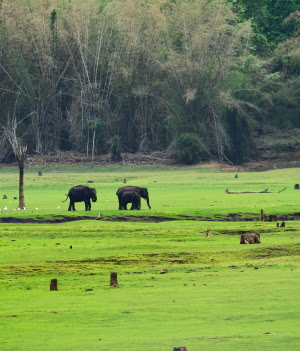
The route is simply unbelievable, but it does come with some restrictions owing to forest department regulations. This Vazhachal forest route is a part of the elephant migration corridor where the pachyderms move from the Anaimalai and Parambikulam Tiger Reserve to the Chimmony Wildlife sanctuary and the Idukki district of Kerala. In fact, this belt has one of the highest elephant and tiger populations in the country. Hence, this route is open only from sunrise to sunset and that too one has to enter vehicle and personal details at each forest check post. This is only for keeping track of visitors and to launch a search and rescue mission if required.

The dense Vazhachal Forests
The entire route is a ‘plastic free’ zone. The forest department takes a count of all the plastic belongings that you carry inside and that count will be matched at the other end of the forest. But over and above these forest department best practices, I think we ourselves should be good Samaritans to ensure that the forest remains pure and pristine forever. To ensure that you have a hassle free journey, ensure you carry enough fuel on you. The nearest fuel stations are either Valparai or Chalakudy in Kerala. A good 105 kms separate both these destinations. Also, a good motorcycle maintenance kit and a first aid kit is recommended to ensure you don’t get stuck in the middle of nowhere for long. Do give this place a visit if you wish to be one with nature even though you are on a motorcycle!

Read more...

Monday, May 14, 2012

Guest Post: Things to do/experience while visiting India

For most travelers, a business visit or a vacation to India will be one of the most memorable experiences of their lives while at the same time being something of a culture shock. Be prepared for the contrast between the modern face of the thriving commercial India, and the abject poverty of some of the population that you will see all around you as you travel. You may well be shocked at seeing beggars in the streets. That having been said a visit to India can be a rewarding and a remarkable experience. I have been twice now and I would recommend a visit to anyone. India is vast, with a very large population, and lives up to its reputation for being extraordinary in many ways. Wherever you choose to visit in India, your trip is sure to be filled with exotic flavors, colors, sights, and sounds.

Preparation and safety tips
When you travel to India you are visiting a culture that is exotic and alien to you, and the trip will require some preparation if it is to be a success. Book your accommodations in India well in advance and check the local weather for the time of year to avoid the monsoon season if possible.

Once you arrive it is necessary to remember that, even though many hotels are modern and attractively decorated, you should still take some precautions with regards to health and hygiene. The tap water in particular should not be trusted; bottled water is generally easy to find, and should be used for drinking and brushing your teeth.

As a general rule of thumb, it is best to avoid the food sold by the street vendors. Additionally, as is the case elsewhere, the water in restaurants should be bottled and should be opened at the table. It is also a good idea to carry a supply of disinfecting wet wipes to use before eating. One interesting side note: the local custom is to use only the right hand for handling food, as the left hand is considered unclean and therefore unsuitable.

There are a number of things to do and experience in India that will help to make any trip to this enchanting land a memorable one. Here are just a few suggestions:

Visit the Taj Mahal
Perhaps the most famous and iconic destination in all of India is the Taj Mahal. Located in the city of Agra, a visit here is well worth the effort regardless of the part of the country you spend the majority of your trip visiting. Visitors walking in the grounds will admire the beauty and symmetry of this massive marble tomb. It was built by the Emperor Shah Jahan in memory of his third wife, and was completed in 1653. A UNESCO World Heritage Site, the Taj Mahal lives up to its reputation as one of the Wonders of the World.

See the Golden City
When visiting western Rajasthan, heading through the sand dunes on a camel-trek will eventually bring you to the city of Jaisalmer. Known as the Golden City, Jaisalmer is home to a spectacular walled fortress that dates back to 1156 AD; the sunset over its centuries-old walls is a feast for the senses.

Experience Jaipur
If you like elephants then you will need to head for Jaipur, where these giant creatures are trained to ferry visitors up the hill to the castle. The ride is unforgettable, and the castle itself is well worth the visit. It is also quite common to catch sight of a local mahout – or elephant rider – riding an elephant through the city center. There are a number of other areas in India where elephants are ridden through the streets, including in the south-west state of Kerala.

Visit the Golden Temple
For adventurous travelers the Golden Temple, or Harimandir Sahib, which is located in Amritsar in the Punjab, is a rewarding and awe-inspiring sight. Located in a distinctive and enchanting part of the country, the current incarnation of the Golden Temple was finished in 1764 and is known for the gold plating and marble of its exterior, and the massive frescos and assortment of gemstones that decorate the interior.

Attend a festival
India is home to hundreds of festivals, and regardless of when you visit; the odds are that some of the locals will be celebrating a local deity or an historic event. For example, Diwali is a five-day festival that takes place in late October or early November each year; called the “Festival of Lights”, it is known for its spectacular fireworks. Holi is known as the “Festival of Colors”, and is celebrated in March each year.

This article has been written by Sam Black, a freelance travel writer. 

Read more...

Tuesday, May 08, 2012

Shyok River: A Beautiful Himalayan River from Northern Ladakh

The glacier-fed Shyok river is one of the main reasons for the extremely pretty and fertile Shyok and Nubra valleys. This tributary of the Indus river originates from the Rimo glacier, one of the tongues of the Siachen glacier, flows along the Pangong range of Changthang, does a ‘U’ turn and joins the Nubra river. It is the valley of these rivers that is known as the food bowl of Ladakh, allowing exotic fruits like seabuckthorn berries, apricots, almonds, etc. to grow here.

The Shyok river flowing in from the Changthang Cold Desert and before it joins the Nubra river
The Shyok and the Nubra then enter Pakistan and join the Indus river. The entire river is quite a sight in all seasons, especially in the summers when it glitters in emerald colors. This picture is of the Shyok river from a curve on one of the Himalayan roads that connects Khardung la to the town of Diskit

Read more...

Monday, May 07, 2012

Wild Horses from Changthang Cold Desert

I am always amazed when I see animals thriving in unforgiving conditions. But, that is how nature provides for and protects all its species even in the toughest conditions. Hence, even in one of the coldest places on the planet, the Changthang Cold Desert, the wild horses seem to be perfectly at home.

The famous horses of Changthang Cold Desert
Their thick fur and their ability to sniff out grass even in the driest of terrain make them survive these supremely cold conditions. While most of these horses roam wild in the cold desert, some of them are tamed by the Changpa nomads and used as ‘beasts of burden’ to transport precious pashmina wool and the likes.

Read more...