Jaisalmer - Be On The Road | Live your Travel Dream!
none

Tuesday, September 23, 2014

Portrait Stories from Rajasthan

The colorful state of Rajasthan offers a lot to the traveler. It has forts, palaces, beautiful bazaars, great food and lots of history. But, I connect the most with its people. I don’t want to sound biased, but sometimes I feel that they are the most hospitable state in India. The people of Rajasthan are so very nice and so eager to help people. I have been all around the state a multitude of times and have had my best people experiences in this state. The Rajasthani people have always welcomed me with both their hands and their warm hearts.

Local musician playing his music inside Jaisalmer Fort
Story: This old man with a very kind face was sitting outside the Jaisalmer Fort and playing this traditional musical instrument (Does anyone know the name of this instrument?) He seemed to be very content and happy playing his music and did not seem to be interested in receiving any money, but when our group gave him some money, he was overjoyed.

And since I like the people of Rajasthan so much, here is a short portrait story from my recent trip to Jodhpur and Jaisalmer. I hope you enjoy them as much as I did while I spent time with these various personalities.

Rajsthani man with big moustache in front of his silk scarf shop at Jodhpur
Story: This Rajasthani man with the big moustache sells scarves at one of the souvenir shops in Mehrangarh Fort. He speaks French, Italian, English and Spanish fluently and is quite a good salesman. He was kind enough to give me tips on how to grow moustaches like his. He even shared some of his older photos and we shared a good laugh.

A street hawker selling peacock feathers at Jaisalmer
Story: This sardarji was selling peacock feathers in the Patwon ki Haveli campus where I spotted him. I tried engaging in a conversation with him, but he was more keen on selling his peacock feathers to me.

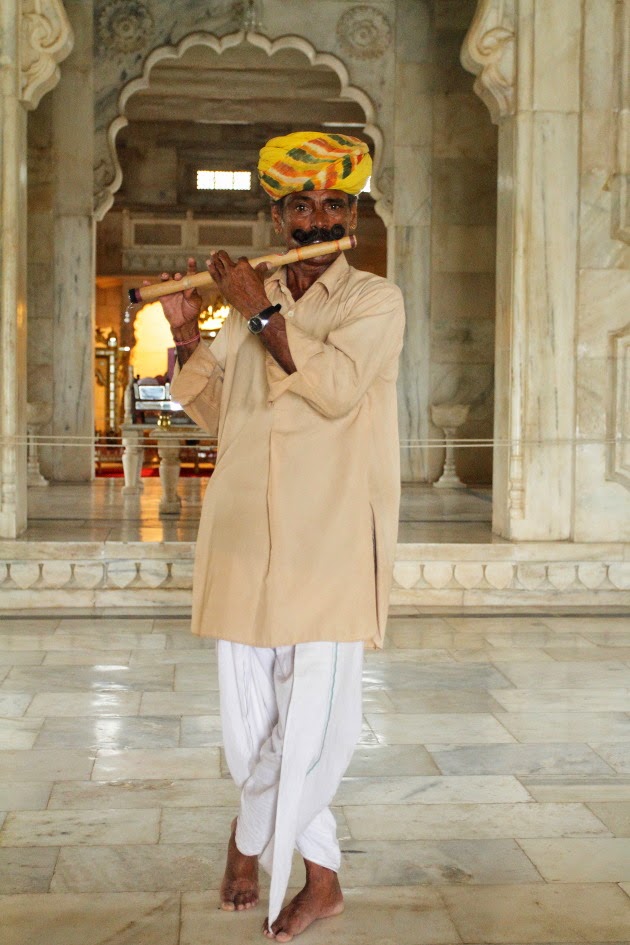
Flute Artist at Jaswant Thada, Jodhpur
Story: This Rajasthani man has been playing the flute for more than 35 years. I met him at Jasvant Thada in Jodhpur. His flute music echoes in the inner chamber and he charges tourists if they wish to record his music. If you just want to listen, it is free, he says.

Camel Mahout and his camel at Ossiyan, Rajasthan
Story: He is a part farmer and part camel mahout. During the tourist season, he takes his guests on camel safaris in the deserts off Ossiyan and when it is lean season, he either tills his small piece of land with his sons or does some odd jobs to make ends meet.

Rajasthani guard at Mehrangarh Fort, JodhpurRays of the setting sun on the jharokas of Mehrangarh Fort, Jodhpur
Story: This guard at Mehrangarh Fort was kind enough to explain me Mehrangarh’s history for more than 30 minutes. He was happy to know that I am from South India and asked me questions on how I spoke Hindi so well. His entire family is associated with the Mehrangarh Fort.

Jain priest at Jaisalmer's Jain Temple
Story: I met this Jain priest at one of the Jain temples inside the Jaisalmer Fort. He was kind enough to talk about Jainism, the temple history and to pose for me.

Local Rajasthani Woman singing at Surygarh
Story: Rajasthani women are very shy and do not like to get their photo clicked. Hence, you don’t see portraits of women in this post, but this one is the exception. I saw this local village lady at Suryagarh. She was singing folk music and her voice boomed through the courtyard.

Local guard at Mehrangarh Fort, Jodhpur
Story: A very kind soul who noticed me on each of my visits to Mehrangarh and on my last visit, he asked me ‘ Aap pichle do din se aah rahe hain na?’. I said ‘Yes’ and began conversing with him. We spoke about his family, his work, the history of Mehrangarh, the raptor feeding tradition at Mehrangarh and much more. It was a pleasure conversing with him.

At a traditional carpet shop in Jodhpur
Story: I was with some Vietnamese girls who wanted to buy a silk carpet as a souvenir back home and they wanted me to bargain for them. While I was talking to him, I got to understand how he made the carpets sitting there with his hands and how they are 70% silk and 30% cotton and much more. The good news was that both my Vietnamese friends bought a carpet from him making him happy.

A Rawan Hatha Street Musician from Jaisalmer
Story: I met this musician in front of the Gadisar Lake. He plays the Rawan Hatha musical instrument and is from a village in the desert outside of Jaisalmer. He even showed me his Rawan Hatha music CDs that he sells to make a living. He was even kind enough to allow me to try playing his Rawan Hatha (unfortunately, I am not good with musical instruments and couldn’t get the hang of it).

At a Jodhpuri shoe shop in Jodhpur
Story: Another multi-lingual salesman, he sells Jodhpuri shoes at the Mehrangarh Fort. He was also one of those people who noticed me coming to the fort every day for the past 3 days and was curious to know why I visited every day.

Elderly Rajasthani Gentleman and the Jaisalmer view
Story: This elderly man is a guard at the Jaisalmer Fort. He was enjoying the breeze at one of the fort windows and on seeing me asked me to enjoy the breeze too. A quiet man, he obliged me to take his photograph.

Local Rajasthani boys on a holiday to Mandore garden, near Jodhpur
Story: These kids thought I was from Africa and started to practice their English with me, but when I started conversing with them in crisp Hindi, they were surprised, but warmed up quickly and started talking to me more. Typical inquisitive Indian questions and at the end of which, they wanted me to take their group picture and I happily obliged.

Continue Reading...

Friday, September 19, 2014

The Desert Remembers

It is a warm and humid night, but I feel a chill up my spine. I am on the famous chudail trail eagerly looking either side to spot these ghosts. My guide tells me not to pick any jewel or money from the cemetery that I am walking through, else the chudail might come to haunt me irrespective of my location. He also tells me stories of how people have either disappeared or lost their mind while walking through this very trail. With senses heightened, all of us in our group stick close to each other as we walk through the various cenotaphs and sati sites in the abandoned village of Kuldhara. We didn’t spot any ghosts, but found our way into the deep-rooted history of the mighty Thar desert.

Jaisalmer fort as seen from the top of Patwon ki Haveli

This chudail trail is just one of the many off beat trails you can explore in the desert of Rajasthan. I was privileged to explore many of these off beat trails as I traversed a part of the ‘The Desert Remembers’ route that has been mapped by Suryagarh, a luxury palace hotel located just outside of Jaisalmer and in the Thar desert.

Sonal Qila and Jaisalmer city

I stayed 3 days with Suryagarh and during these  three days, I got to see a side of the desert that I never knew existed. This desert that I explored is home to abandoned villages, cenotaphs and cemeteries, sati sites, intelligent irrigation systems, the famous silk route, lots of trading history, many oasis and forts and very intricate jain temples. It is a great sense of excitement as you explore this part of the desert in the lost sands of time. And while you are at it, you can explore the popular attractions of Jaisalmer and enjoy the plush Rajasthani hospitality and their delicious food.

Elderly Rajasthani Gentleman and the Jaisalmer view

Below should give you a good idea of this ancient route in the desert that I traversed. 

Paliwal Community – Intelligent Desert People

Folk Songs at Suryagarh

Everything in this part of the desert owes its roots to the intelligent Paliwal community. Hence, most of ‘The Desert Remembers’ route pays homage to these people by passing through their villages, their irrigation systems, their temples, their cenotpahs and the likes. Personally, as I understood more of the Paliwals, who were once very successful traders and built prosperous settlements in the desert, I got to understand the desert history better.

Village temple in the middle of the Thar desert

Originally from Pali, these part merchants and part cultivators moved into the deserts off Jaisalmer in the 12th century. They were great traders and established themselves as an important cog on the famous silk route. Between the 16th and the 18th centuries, they traded with Kabul, Arabia and even China.

Wild camels roam near a village in the Thar desert

They were also so intelligent that they devised the Aagor, Khadeen and Dhora irrigation technique that still exists in the desert. This irrigation technique helps replenish the water table with whatever little rains the desert gets and makes way for lush agriculture. Even to date, farmers make use of these agriculture zones to grow chana, bajra and some vegetables. I got to see this live and to say the least I was stunned. Drinking water, sustained agriculture and greenery is all possible due to this archaic and yet intelligent system.

Desert landscape in the monsoons

They were the masters of the desert and built themselves a secure and prosperous life for over 6 centuries till one day, when they abandoned all their 82 villages and moved on to other places. Today, the villages are in ruins, but its temples, irrigation methods and stories give you a sense of the skill of these Paliwal people. And there are lots of stories (folklore, love, hatred) that you can hear. I can tell them here, but you would connect better when you are there in these Paliwal villages.

Breakfast with the Peacocks at Khaba Fort
 
Sunrise breakfast at Khaba Fort in the Thar desert

While we stay with the Paliwals and the silk route, we move to Khaba Fort, an important connecting point between Sindh and Jaisalmer for the traders on the Silk Route. This fort, overlooks the stranded Paliwal villages and makes for a stunning sight during the early morning hours as the entire ruins come to view with the shining sun. It is also here that a local boy comes to feed bajra seeds to peacocks every morning.

Deserted Paliwal village as seen from Khaba fort

This is part of an ancient family tradition and makes for a lovely sight as the call of the peacock booms through the ruins. And, this was also the place where I enjoyed my breakfast with these peacocks and the ruins. To be honest, this was the first time I experienced having breakfast with at least 50 peacocks and I have to say that it was quite a surreal experience for me.

Paliwal Cemetries and Cenotaphs

A Rawan Hatha Street Musician from Jaisalmer

The eerie chudail trail finds its home in these Paliwal cemeteries where different cenotaphs of travellers and Paliwals can be found. The Kuldhara village is famous for these cenotaphs and also for the sati sites where the wives of these men burnt themselves. As you move through these cemeteries you can see pillars with carvings of the man and his wife and sometimes even the travelers. These sati stories are an integral part of the desert lore.

Dinner by an Oasis
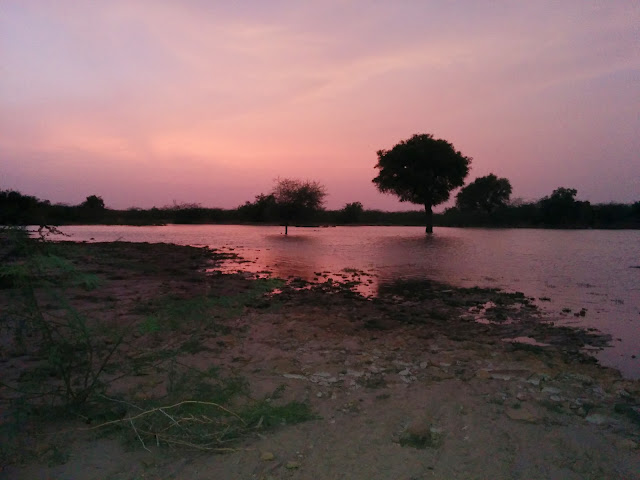
Sunset over an oasis in the Thar Desert

The desert is wide and vast with very minimal life, but in small pockets, they are lush green, offer food for the animals, are a source of precious drinking water and act as perfect cultivating grounds. This is because of the famous irrigation system devised by the Paliwals. You can understand the irrigation systems by day, watch the sunset over an oasis by the evening and enjoy dinner under the star lit sky. The icing on the cake is communal style eating, live Rajasthani folk music, more stories and a star studded sky.

Ludrava – The Erstwhile Desert Capital

Intricate work on the entrance gate to the Jain temple in Ludrava

The next stop in the desert is the erstwhile power seat of the Bhatti dynasty, Ludrava where the kingdom used to exist till it got moved to Jaisalmer for lack of security measures (Ludrava is very close to the Pakistan border and thus offered easy access to the Muslim warriors). It is here that you can see the extremely intricate and beautiful Jain temple that is dedicated to the 23rd Tirthankara. The carvings, jhorakas, statues and its torana is quite a sight.

Beautiful Jharokas on the walls of Ludrava Jain Temple, near Jaisalmer

A slow exploration of this village also reveals many architectural ruins and other temples amidst the surrounding sand dunes and takes you into a world that reminds of the city’s former glory.

Sam and Khuri Dunes

Desert Safari

The desert of Rajasthan is famous for its rolling sand dunes that are the most eye catching during sunset when the sand takes on the golden hues of the sun. This is the iconic part of the desert and is famous for its camel safari, visit to remote villages, staying in desert tents, eating ker-Sangri under the desert sky, talking to nomads, dune surfing and much more.

Desert National Park

Local musician playing his music inside Jaisalmer Fort

Right in between Sam and Khuri lie the quiet desert national park that is home to endangered species of animals like the Great Indian Bustard, Houbara Bustard, Vultures, desert fox and many more. This national park is a great way to explore the desert wildlife and is perfect for birdwatchers looking for a relaxed birding experience. A lot of ancient fossils have also been found in and near this desert national park.

Delicious Marwari Food

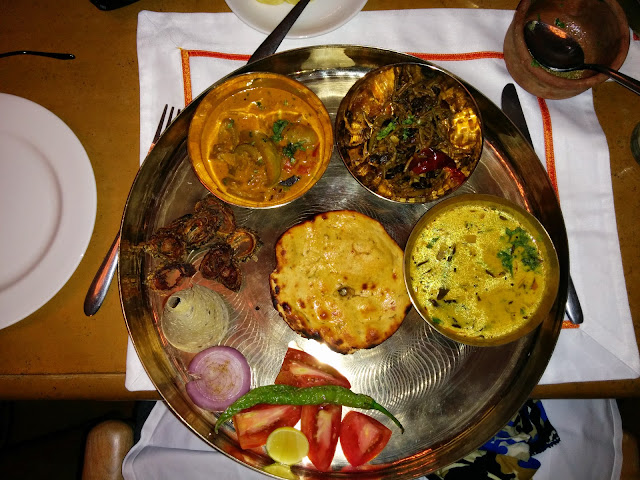
Delicious Marwari Thali at Suryagarh

A Rajasthani desert experience is not complete without tasting their traditional Halwayi Breakfast and the uber delicious Marwari Thali. The Halwayi breakfast is a very famous desert culture where people have mirchi vada, samosa and kachori with their ladoos, jalebi, rasmalai and other sweets in the morning. And the Marwari Thali comes with Bajra and Missi Rotis with Gatta Masala, Kher Sangri (a desert specialty made from a desert bush stem and its berries), Kadi, Daal and veggies. For more delicious local food, there is daal baati choorma. And then there is the thick lassi or chaach to help you smack your lips in pure joy. And there is no better to enjoy this than at Suryagarh who have the best Halwayi in this part of the world and some of the best traditional chefs. I would just return to them to indulge in their rich culinary experience once again. And just so you know, they specialize in continental and international cuisine too.

Jaisalmer Fort and the Havelis

The city view that the queen used to see from the palace in Jaisalmer Fort

Locally known as the Sonar Qila, the Golden Fort of Jaisalmer towers over the city of Jaisalmer. The only living fort in this part of the world, it is a constant bustle of activity with locals and tourists alike. It’s rich history, its beautiful interiors and the Jain temples in its fold all offer a great ride into the glorious past. The aerial view of the desert city, the Pakistan border and the wide desert from its tower area is the highlight of this fort.
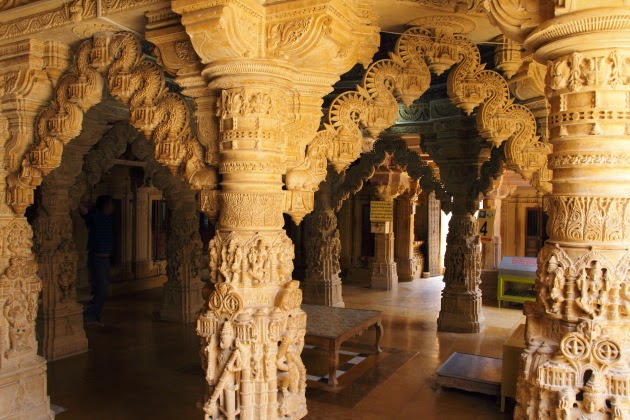
Intricate work inside the Jain temple of Jaisalmer

As you step outside the fort and into the narrow lanes running parallel to the market, you will notice the famous Havelis of Jaisalmer. These havelis were built by rich Jain merchants and many of them still retain most of their erstwhile glamour and opulence. The paintings, the rich interiors, the immaculate glass work, the jhorakas and the view points will make you think about their rich life hundreds of years ago.

Jain priest at Jaisalmer's Jain Temple

Some of these Havelis are museums and run by the government, while the others are still owned by the family. All of them offer a unique experience. The Patwon ki Haveli and Nathmal ji ki Haveli are the two most impressive ones.

Silver, Gold and Handicrafts

Shopping at Jaisalmer

The silversmiths and goldsmiths of this part of the desert are known to make the best ornaments. Some families have been known to create the smallest and the most intricate designs. If you are into jewelry, these items will make for great souvenirs.

Local handicrafts on sale outside Patwon ki Haveli, Jaisalmer

Like with the food, the colourful markets of Jaisalmer are iconic and are known for its handicrafts and embroidery work. Wall hangings, bed sheets, cushion covers and many others make for great souvenirs to take back home. The famous Marwari sweets are also great to take for your family and friends.

Luxurious Suryagarh Experience

Beautiful courtyard of Suryagarh, Jaisalmer

The last, but not the least is the super rich and luxurious experience of staying at Suryagarh.  Well, it is quite something to stay in a luxury palace (which is sensational in its own right), but where Suryagarh connected most with me was its rich folk connection, lip smacking food (I can’t help it, I am a foodie) and their intent to ensure that I had a good time. Here are some examples to help you understand my train of thought better. According to me all were surreal experiences as it is rare to find them elsewhere.

1) Enjoying my Halwayi breakfast in the open courtyard and under the morning sun while listening to the soothing flute music played by a local Rajasthani gentleman. I sometimes wish all my breakfasts were like that.

2) Having my evening tea while listening to a local Rajasthani woman sing her folk songs. This woman had such a booming voice that sometimes I felt like I had transponded to a different world.

3) Luxury seeking, adventurers, vegetarians, night people, Spa lovers, Workout enthusiasts, etc. My group had all kinds of people and all of us had a bang-up time. The people at Suryagarh want their guests to have a rare and yet surreal luxurious experience and to make this happen, they don’t leave any stone unturned.

Thank you Suryagarh for taking me on this amazing journey. I will always cherish it and hopefully, will return soon.

A street hawker selling peacock feathers at Jaisalmer

Travel Tips for the desert

1) Carry a good pair of walking shoes as you might have to walk into different desert trails.
2) Stay hydrated
3) Wear sunscreen, a hat and a pair of sunglasses to protect you from the desert sun
4) Carry a torch or a headlamp while exploring the Chudail trail in the night

Continue Reading...

Wednesday, August 20, 2014

Top 12 Things to do in Jaisalmer, Rajasthan

On my recent backpacking trip to Rajasthan, I spent a lot of time exploring the city of Jaisalmer, its suburbs, the Thar desert and its remote villages, the remote temples, the ancient irrigation villages and much more in the desert. You get a feeling that the desert remembers and there is a lot of magic during the monsoons in the desert. If you are planning a holiday to this desert region of Rajasthan, these top things to do in and around Jaisalmer might come in handy for you. And all these tips are based on my recent experience and could potentially become something of a virtual Rajasthan tour guide for you.

Courtesy: These are signature experiences of Suryagarh, a boutique luxury hotel that allows you the explore the unexplored. If you wish to experience these signature experiences while indulging in some royal Suryagarh luxury and true Rajasthani hospitality, you can directly reach out to them at www.suryagarh.com for bookings and more details.

See the City View from Jaisalmer Fort

Sonar Qila and Jaisalmer city view

The Sonar Qila or Golden Fort is the largest living fort in India and one of the top desert highlights of Rajasthan Tours. Made out of yellow sandstone, it towers over the desert city of Jaisalmer, one of the top places to visit in Rajasthan. It is struggling with sanitary and drainage problems, but amidst all these problems, it has managed to maintain a lot of its historical beauty. The museum, the palace and the tower are completely worth the 60 to 75 minute audio guide tour. The icing on the cake is the stunning 360 degree view from the top tower. You can see the entire city, the Jain temples, the Pakistan border and the desert.  

Gadisar Lake in the Evening

Evening at Gadisar Lake, Jaisalmer
If you feel like enjoying the evening breeze, go for a boat ride or listen to some bhajans being sung at local temples, then Gadisar Lake is the place. This lifeline of this desert city has the same yellow sandstone architecture as the rest of the city. The place is a big hit with the locals who come here in huge numbers every evening and especially during the weekends.
 
Marwari Thali and Halwayi Breakfast

Marwari Thali
The Marwari thali and Halwayi breakfast is an integral part of the desert culture of Rajasthan. Bajra roti and Missi roti with Gatta Masala and Kher Sangri tastes delicious for lunch and dinner. And for breakfast and an evening snack, mirchi vada, kachori, samosa, ladoos, lassi and other sweets make for a lip smacking experience.

Breakfast with the Peacocks at Khaba Fort

Breakfast at Khaba Fort
Every morning, about 50 to 100 peacocks fly in from all over the ruins of a Paliwal village at the call of a local boy who has been following a long family tradition of feeding bajra seeds to these peacocks. This happens very morning around sunrise and makes for a great sight as you not only get to see these peacocks, but you get to see the sun rising over the ruins of the abandoned Paliwal village. And once you are done with your breakfast, you can explore this small, yet important historical fort and its 2 temples.

Richness of Patwon Ki Haveli

Living Room in Patwon ki Haveli
There were a lot of successful merchants in the hey days of Jaisalmer and through their success, they made a lot of money, which they used to build extremely luxurious houses for themselves.  These uber rich houses are called havelis and many of them still exist to this day. They are located within the city area and very close to the fort and the main bazaar. The richest and the most well maintained haveli is the Patwon ki Haveli where you can see a museum that holds artefacts of their rich past. This haveli also offer stunning views of the Jaisalmer fort.

Dinner by an Oasis

Oasis in the Thar
This is one of the true luxuries of the desert life. Spending an evening under the star lit desert sky, listening to some folks music, swaying to the cool desert breeze and eating local dinner is quite an experience.

Camel Safari at Sam or Khuri Dunes

Camel safari on the sand dunes of Rajasthan
When anyone speaks of the mighty Thar, the image of the rolling sand dunes immediately come to our mind. We have seen a lot of such images from our movies, but it is even more surreal to see and feel it in real life. Going on a camel safari at around sunset and watching the sand dunes dancing in the golden hues of the sun is quite a sight. It is here at the sand dunes that we can indulge in dune surfing or dune boarding and then there are these nomadic villages close to Sam and Khuri that are worth visiting. And then who can miss either the dinner on the sand dunes under the star lit sky or staying overnight next to these sand dunes in desert tents or traditional mud houses.

Kuldhara Chudail Trail


Camels near a village in the Thar
If you are up to chasing ghosts in an abandoned Paliwal village by night, then you have to go on this trail. Surrounded by cemeteries, cenotaphs and ruins, this trail is believed to be occupied by female ghosts (chudail) who have been spotted by many male travelers with each of them having their own epic stories. Even though I did not spot any chudails, the eerie level on the trail was pretty high and the entire group stayed together for comfort.

Paliwal Villages and the Silk Route

Paliwal Village as seen from Khaba Fort
The Paliwals were successful citizens of the Thar desert from the 11th to the 16th century. They were part merchants and part cultivators. They designed indigenous irrigation systems like the Agor, Khadeen and Dhora that allowed them to harness water in the desert. Due to this smart invention, the people of the desert still get to cultivate bajra, chana and vegetables in the desert. They were also good traders and did successful business with China and the Middle East across the famous Silk Route. Then, one fine day, due to poisioning of their drinking water supply, they abandoned all their villages and left this part of the desert for good. If you wish to know more about their history, see the irrigation systems in place, feel their stories through their abandoned villages, cemeteries, cenotaphs and sati sites, then this is one of the top off beat things to do in the Thar desert.
 
Exquisite Jain Temple at Ludrava

Torana of Ludrava Jain Temple
This temple blew me away from the moment I walked into it. The attention to detail, the sheer intricate work, its beautiful jharokas and its  unbelievable torana (entrance gate) are exemplary. This temple is Jain dedicated to the 24th tirthankara is a beautiful fusion of Jain beliefs and folklore that they heard from their Chinese trader friends. This entire town, Ludrava was the capital of erstwhile desert kingdom before it moved to Jaisalmer.

Jain Temples inside Jaisalmer Fort

Sculptures in the Jain temple of Jaisalmer
While the Ludrava temple is outstanding, the other Jain temples in the Jaisalmer fort are not far behind. They are equally beautiful and  sport the same yellow sandstone construction with intricate architecture. These temples are extremely popular with Jains and also many Hindus.  If you have time, make sure you get to understand the meaning of each of the carvings on the inside temple walls. There are a lot of stories and beliefs portrayed here.
 
Shopping for local embroidery work at  the Jaisalmer market

Shopping for embroidery work at Jaisalmer 
The markets of Jaisalmer are colorful with bright textiles, spices, carpets and much more. If you feel like taking home a souvenir, you can try picking up a hand embroidered wall hanging, cushion cover, bedsheets and much more. You can also buy the famous Halwayi items like laddoos and other sweets.  In simple terms, it is a colorful shopping extravaganza.

Continue Reading...

Saturday, August 09, 2014

Travel Photo: A Jaisalmer Moment

There is something infectious about Rajasthan that keeps attracting me to it. While Jodhpur was unbelievable, Jaisalmer presented a different look that made me wish I stay there forever. The Sona Qila, Jaisalmer’s golden fort is the star attraction of this city along with the mighty Thar desert and hence my Jaisalmer moment is inside this fort while I was looking at the golden buildings in the horizon from it.

Elderly Rajasthani Gentleman and the Jaisalmer view
While I was listening to my audio guide and making my way through the fort, I noticed this elderly Rajasthani sitting by a window and grabbing a breath of fresh cool air (The humidity levels were stifling that day in Jaisalmer due to the rains). While my body seemed to appreciate the cool breeze, my mind seemed to appreciate the view of this man and the dry city landscape beyond. I made small conversation with him and during this I asked him if I could click his picture and like all hospitable Rajasthani people, he smilingly obliged and this is the output. Do you like this Jaisalmer moment of mine?

Continue Reading...
Logo Credits : Jobi T Chacko. UI/UX Credits : Murugan S Thirumalai
Copyright © 2009-2026 Sankara Subramanian C (www.beontheroad.com)
Reproduction without explicit permission is prohibited. All Rights Reserved

Join the Travel Club for FREE!!
and every fortnight get in your inbox...interesting experiential and off-beat travel stories , destination guides, handy tips (travel, photography and visa) based on personal experience, global vegetarian delights with helpful survival guides and gorgeous world travel images and videos as I (the Indian traveler) trot the globe! And a lot of other travel invites and soon to be launched goodies !

* indicates required
Close