Pamukkale - Be On The Road | Live your Travel Dream!
none

Monday, March 15, 2021

Hierapolis: The Ancient Greek Spa City
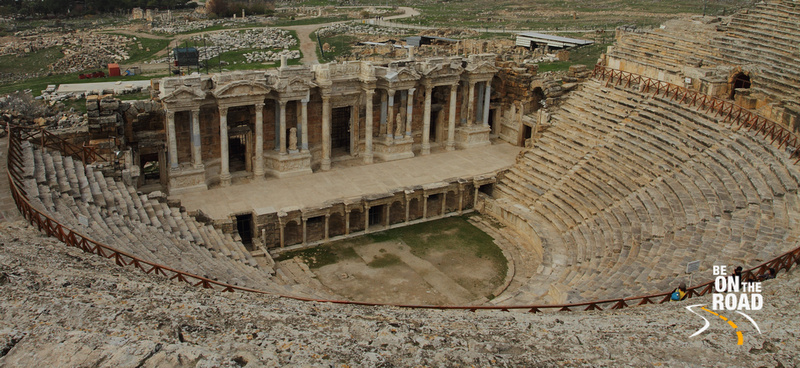
The mighty amphitheater of Hierapolis, Turkey

Turkey is a holiday destination with amazing experiences. It’s unique location on the cusp of Europe, Asia and the Middle East makes it a melting pot of cultures, home to an amazing array of landscapes and a land of delicious food. One such gem in Turkey is the ruins of the ancient Greek city called Hierapolis. Founded in early 2nd century BCE, Hierapolis is a UNESCO world heritage site that in its hey days used to exist as a spectacular spa destination.

This ancient Greek spa city, located on natural hot springs in southwestern Anatolia, was home to spectacular baths, a massive amphitheatre, temples, grand gateways, markets, sacrophagi and much more. Today, its ruins give us a glimpse into its rich past.

Pamukkale Travertines and Hierapolis Ruins

It all started when the Phrygians built a temple in the first half of the 7th century BCE, which was used by the people of the nearby villages and towns. Then, in the 2nd century BCE, Hierapolis was founded as a thermal spa. It started as a healing centre, before people started to migrate here to spend their last days in relaxation and peace. With time, Hierapolis or the holy city expanded from being a health centre into a city with numerous temples. In 133 BCE, Hierapolis became the part of the Roman province of Asia after the death of King Attalus III. Then onwards a couple of earthquakes damaged the city and it was entirely rebuilt in the Roman style with imperial financial support. By now, Christianity had made its presence felt in this city.

Then came the golden era of the city starting 129 ACE when the theatre was built for a visit by the emperor Hadrian. And when the Roman Emperor Caracalla visited in 215 ACE and bestowed upon it the title of neocorus, Hierapolis entered the peak phase of this golden era. Roman baths, gymnasium, temples, fountains and markets were built. Hierapolis became one of the more prominent Roman cities in the field of art, philosophy and trade. The citizens started getting richer and the city thrived. All was well till the early part of the 7th century when the town was attacked by Persian armies and then by an earthquake. Thus began the decline of this once great spa city.

Main street way of Hierapolis, Turkey

As you walk through the ruins of this ancient city, you cannot stop admiring its massive size, be its baths, amphitheatre, temples or just its building columns. Not only are the structures of Hierapolis big, but they were tastefully built with a lot of utility functions. All the remaining stones and ruins tell you a story and each vantage point gives you a majestic view of the landscape that is made up of rocks, stones and white travertines.

You can either take a taxi to Hierapolis, explore the city by foot, enjoy a dip in the thermal waters and walk your way down to the town of Pamukkale through the travertines and waterfalls or you can walk your way up from Pamukkale through the different travertines, exploring every bit of it in the cooler morning weather, then exploring the ancient Greek city of Hierapolis and then walking all the way back to Pamaukkale through a different route in the travertines. Either ways, you are bound to enjoy the ruins of Hierapolis and the travertines of Pamukkale. Throw in a paragliding adventure, a relaxed soak in the hot water springs and a deliciously cooked local meal and you have a dream Hierapolis and Pamukkale holiday experience.

Ruins of Hierapolis Temples

As I had mentioned earlier, Turkey is a holiday destination with many amazing experiences. All you have to do is book your tickets and Turkish visa and you are all set to have a dream vacation that includes the ancient Greek spa city of Hierapolis and many other magical destinations.

Tourists enjoying the hot waters of Pamukkale's travertines

How to reach there:

The nearest airport, train station and bus station would be Denizli. Mini buses or dolmus (share taxi) will take you from Denizli to Pamukkale in about 20 minutes.

The well connected and also the cheapest option to reach Denizli would be by bus.

Best season to visit:

Summers tend to be very hot at Pamukkale and Hierapolis. Hence, they can be best avoided. The rest of the year would be ideal to visit Hierapolis and Pamukkale.

Winters can be a bit challenging as you will have to walk barefoot through the freezing waters of the travertines.

Things to keep in mind:

1) Do carry with you a pair of sunglasses to protect your eyes against the heavy reflections coming from the chalky cascades

2) Do carry with you a cap/hat, sunblock, good pair of boots, a bottle of water to protect yourself from the elements

Admission fee:

The entrance fee is 80 Turkish Lira. This includes both Pamukkale travertines and the Roman ruins of Hierapolis

Entrance gates to Hierapolis

Where to stay:

Pamukkale would be the best place to stay as it offers close proximity to the travertines and to Hierapolis. There are many family run pensions near the travertines for those looking for something more upmarket, while the town has hotels and hostels catering to a wide range of budgets.

Where to eat:

You could either eat at your place of stay in Pamukkale or you could try the delicious street food in the city.

There are also a few restaurants near Hierapolis, where you could get some basic food.

The mineral world of Pamukkale's Travertines

Other nearby tourist attractions:

1) Pamukkale: A UNESCO world heritage site known for its travertines with mineral rich thermal waters&

2) Cappadocia: One of the most magical places in the world

3) Ephesus: An ancient Greek city founded in the early 10th century BC on the west coast of Turkey

4) Aphrodisias: Offbeat Greek culture trail in Turkey

5) Kayakoy: The ghost town of Turkey
;
6) Lycian way: A historic trail with sensational beaches, architectural ruins, rich Greek history and stunning views

Continue Reading...

Tuesday, April 14, 2015

Travel Photo: Travertine Hot Springs of Pamukkale, Turkey

This is a UNESCO World Heritage Site and is one of mother’s nature’s best wonders. Over many years and earthquakes, rivers changed course, cold flowing water became hot water springs, rivers deposited mineral mountains and still kept flowing over it. These mineral mountains are the white travertine hot springs of Pamukkale. They are fed by hot water springs, which are believed to be medicinal in nature. While the waters may have medicinal value, the sight of this travertine is definitely medicinal as they calm our hearts with such sensational beauty. They form streams, waterfalls and ponds as they make their way downhill.

Pamukkale - a must visit place in Turkey

It is best to visit this place on a cold day like how I visited so that you can enjoy the hot water springs and hot bath even more. Do carry your sunglasses and swim wear if you are headed there. And remember, no shoes or any kind of foot wear is allowed here.

Continue Reading...

Monday, February 09, 2015

Kale Hotel: Decent Budget Hostel at Pamukkale, Turkey

Pamukkale is one of those beautiful spectacles of mother nature that it comes under every itinerary in Turkey. And it came under my month long backpacking trip in Turkey too. I stayed at Pamukkale for three days and 3 nights and during this time, I found myself a place called ‘Kale Hotel’ to sleep. The below review is based on my recent experience of staying here.

Travertines of Pamukkale, Turkey

1) Pamukkale is a small town and everything is within a short walking distance, but even in that, the Kale Hotel is located right in the center of things.

2) The place is run by a family, who are simple and cordial. The son speaks Korean and hence the place is very popular with Koreans. They also serve Korean food in their restaurant.

3) Right opposite the place is a happening club and hence the noise levels stay high till about midnight. If you are an early sleeper, ask for the rooms on the back side of the hotel.

4) They have both dormitories and rooms and serve free breakfast, though the breakfast is simple.

5) They offer free wi-fi to their customers and the wi-fi speed is decent.

6) Everything is good about the hotel except for the fact that at many places it looks dirty. Actually, it is because the building is old and needs a new coat of paint.

7) Most of the restaurants, the main entrance to Pamukkale, tour operators and shops are located within close walking distance from the hotel.

This hotel is great for people on a budget. The Kale hotel would be great if it got renovated and got a new coat of paint. Otherwise, a good option for budget travelers.

Continue Reading...

Monday, November 17, 2014

Travel Photo:Gozleme Cook from Pamukkale, Turkey

The last three weeks in Turkey has been a gastronomic delight for me. The food is so delicious here that sometimes I feel like I should settle here for good. While everyone knows of the kebabs, Turkish delights, Baklava and other desserts, I would like to bring special mention to the humble Gozleme. This Turkish pancake is a lunch favorite and is consumed with hot tea, yoghurt and tomatoes. Made from wheat flour and cooked on a hot concave iron plate, the Gozleme is typically stuffed with cheese, spinach, chillies and potatoes and with the meat option, some dry beef is added to it.

Gozleme - a favorite pancake dish of Turkey

This Turkish pancake is cooked in front of you, is easy to digest, costs very few liras and takes only a short while to be ready. I gorged on these pancakes especially in smaller towns where they seem to be the rage(unlike the larger towns where doners are the preferred fast food). They are easy to eat and make for a very healthy picnic lunch that you can take on treks and explorations. In this photo is the mother of the family who makes these gozlemes for the family restaurant at Pamukkale in the Anatolian part of Turkey.

Continue Reading...

Thursday, November 13, 2014

Travel Photo: Hierapolis Theatre, Turkey

Seating close to 15,000 people and nearly 2000 years old, the amphitheatre at Hierapolis is a sight that leaves you speechless. It is part of the ancient holy city that is a UNESCO world heritage site and one that is situated among the beautiful hot water springs and travertines. This was the place where plays, gladiator fights and other performances were played in the hey days. It is located on a hill and is designed with great acoustic taste.

Roman Amphitheater at Hierapolis
Even today, if you sing a song here, the sound booms through the theater and which showcases the knowledge of acoustic engineering even in that age. In my mind, that is truly amazing. In fact, every bit of this ancient holy city captures one’s imagination. It is no wonder that this place is immensely popular with all tourists visiting Turkey.

Continue Reading...
Logo Credits : Jobi T Chacko. UI/UX Credits : Murugan S Thirumalai
Copyright © 2009-2026 Sankara Subramanian C (www.beontheroad.com)
Reproduction without explicit permission is prohibited. All Rights Reserved

Join the Travel Club for FREE!!
and every fortnight get in your inbox...interesting experiential and off-beat travel stories , destination guides, handy tips (travel, photography and visa) based on personal experience, global vegetarian delights with helpful survival guides and gorgeous world travel images and videos as I (the Indian traveler) trot the globe! And a lot of other travel invites and soon to be launched goodies !

* indicates required
Close