Uttar Pradesh - Be On The Road | Live your Travel Dream!
none

Tuesday, August 18, 2020

Akbar’s Tomb at Sikandra: A Mughal Architectural Masterpiece

Entrance to Akbar's Tomb at Sikandra, Agra, India

There is so much more to Agra than the ‘Taj Mahal’. There are its colorful and vibrant bazaars, its other UNESCO World heritage sites (Agra Fort and Fatehpur Sikri), its Mughal era gardens, its river side, its mosques and its iconic tombs.

You are never too far away from a work of art in Agra. One such work of art is the Tomb of Emperor Akbar, located about 10 kms away from the Taj Mahal. This Mughal architectural masterpiece is one of Agra’s top tourist attractions and a must visit on your Agra holiday.

Indo-Islamic architecture of Akbar's Tomb at Sikandra, Agra

Built in the early 17th century by Akbar’s son Jehangir, this mausoleum is famous for its gigantic size, its massive gateways (similar to that of the Buland Darwaza at Fatehpur Sikri), its inlay panels, its jaali work, the front façade, the arches and the decorated tomb itself. Add to it the stunning red monument that stands in the middle of lush green surrounding with blackbucks roaming its lawns and you have an architectural masterpiece.

Window inside Akbar's Tomb, Sikandra, Agra

Akbar’s tomb would have been grander had the Jats not ransacked and plundered the tomb and looted all its jewels and carpets. Thankfully, a lot of it was restored during the reign of the British and later by the Archaeological survey of India. Today, it stands tall in the Sikandra landscape.

Loving Pigeon couple inside Akbar's Tomb, Agra, India

The main entrance is via a massive south facing gate that stands tall with its four white marble chhatri-topped minarets. These minarets are similar to that of the Taj Mahal, but they predate it by a few decades. The red sandstone with which this mausoleum was built offers shades of deep red to the visitor along with gleaming white marble elements and geometric, floral and calligraphic panel designs.

When you look from far, it is its size that is awe-inspiring. But, when you go closer, its inlay panels, geometric patterns and calligraphy captivate your attention.

Male Blackbuck strolls in the premises of Sikandra, Agra

From up close or far away, Akbar’s tomb is befitting his grand status of one of the largest emperors to have ruled the Indian subcontinent. Don’t miss to visit this place on your next trip to Agra. And yes, there is much more to Agra than just the Taj Mahal.

Akbar's Tomb as seen from the main durwaza entrance

Best season to visit:

Akbar’s tomb is open all year round, but there are some good times in case you have a particular agenda.

If photography is on your agenda, avoid the foggy months of Dec and January.

If you wish to visit during the summer months, make sure you get there first thing in the morning.

The rains bring in lower crowds, but offer stunning perspectives. This time makes for vibrant photographs.

Beautiful work on the ceiling of Akbar's Tomb, Sikandra, Agra

How to reach there:

The nearest domestic airport would be Agra, though connectivity options would be limited. The other nearest domestic and international airport with great connectivity would be New Delhi international airport (about 2 to 3 hour drive from Delhi to Agra).

The nearest railway station would be Agra. Agra has two main railway stations – Agra Fort and Agra Cantt. Both stations are well connected with the rest of the country.

Agra enjoys great road connectivity with other cities as it is on the golden quadrilateral route of India.

Sikandra is about 10 kms from Agra city. One can take the bus or hire an autorickshaw or cab to reach Akbar’s tomb in Sikandra.

Blackbucks grazing on the fields surrounding Akbar's Tomb at Sikandra, Agra

Where to stay:

Agra would be the best place to stay as it offers accommodation that caters to a wide range of needs and budgets.

Antique lamp inside Akbar's Tomb, Sikandra, Agra

Other nearby tourist attractions:

1) Taj Mahal – One of the seven wonders of the world

2) Mehtab Bagh – A Mughal era park on the banks of the Yamuna that is known for its fabulous Taj Mahal views

3) Agra Fort – A UNESCO World Heritage site that resembles the red fort in Delhi and that is another magnificent piece of Mughal architecture

4) Baby Taj – One of the prettiest tombs from the Mughal era

5) Fatehpur Sikri – A 16th century city of victory that is also a UNESCO World Heritage Site

Continue Reading...

Sunday, February 12, 2017

48 Hours in Agra

Wah Taj Boliye! Agra, the once capital city of the mighty Mughal empire is where the monument of love, the Taj Mahal is located. Located by the river Yamuna, Agra is more than just a home to the Taj Mahal. It is home to three UNESCO world heritage sites, stunning parks, many other architectural wonders from the Mughal times, a delicious food culture and a vibrant street life.

A jaw dropping view of the Taj Mahal from Mehtab Bagh, Agra

It is a city that you have to visit. It could either be as part of a relaxed holiday or a rushed weekend trip from Jaipur or the capital New Delhi. I have explored this city many times and each time I have experienced something different. If you have 48 hours in Agra, these are my top recommendations!

Sunrise or Sunset at the Taj Mahal

Wah Taj Boliye, Agra

For most, a visit to Agra is just to visit the Taj Mahal. I completely empathize with this craze as I absolutely love this monument too. Such has been my craze that I gape in wonder every time I see the beautiful Taj Mahal. The best time to see and experience the Taj Mahal is either at sunrise or at sunset. If you are visiting during the foggy winters, sunset is recommended. At this time of the day, crowds are lower and the light is better, thus allowing you more time to take those amazing portraits in front of the Taj Mahal.

The view as you enter the Taj Mahal campus

It is best that you book your ticket in advance online so that you can avoid standing in queue at the ticket counter. It is always nice to understand the history of the monument so that we can connect with it better. As I prefer to move at my own pace, I usually opt for an audio guide, but if you wish you can opt for a government approved guide.

A different view of the Taj Mahal, Agra, India

Do remember that the Taj Mahal is closed on Fridays. And that the east entrance is the one with the fewest people.

Siesta at Mehtab Bagh with the special Taj View

A Mehtab Bagh Taj Mahal Moment, Agra

The Persians loved their gardens and specialized in it. This brilliance with gardens and water gardens permeated into the Mughal style of architecture too. Persian styled Baghs or gardens can be found all over Agra. The famous one is the Mehtab Bagh, located on the bank of the Yamuna river opposite to the Taj Mahal. Shah Jahan built this gorgeous garden just to enjoy amazing views of the Taj. You can also enjoy this view by taking an autorickshaw to the other end of the old city.

Taj Mahal as seen from Mehtab Bagh, Agra, India

If you are visiting during the rainy season, this place is perfect for those sunset shots of the Taj Mahal with reflections in the Yamuna and for other seasons, this place is ideal for that afternoon siesta with a surreal Taj Mahal view. May be, you could also read a book here. The best part about this place is that it is so blissfully quiet and a far cry from the Taj Mahal campus which is always bustling and buzzing with people. 

Amaze yourself at the Red Sandstone Beauty of Agra Fort

Local ladies gossip session in front of an ornate door, Red Fort, Agra, India

Housing many palaces, stunning carvings, gorgeous marble work and a bird’s eye view of the Taj Mahal, the red Agra Fort is where I would go straight after an early breakfast. An UNESCO world heritage site, the Agra fort, which looks very similar to the Red Fort of Delhi is so well preserved and hence is a special treat to the eyes.  Do compare notes when you visit New Delhi’s Red Fort, which holds iconic status and where India’s Independence Day and Republic Day events are held. Do check out the Expedia guide to New Delhi to know more about such charms, attractions and off-beat locations in India’s capital.
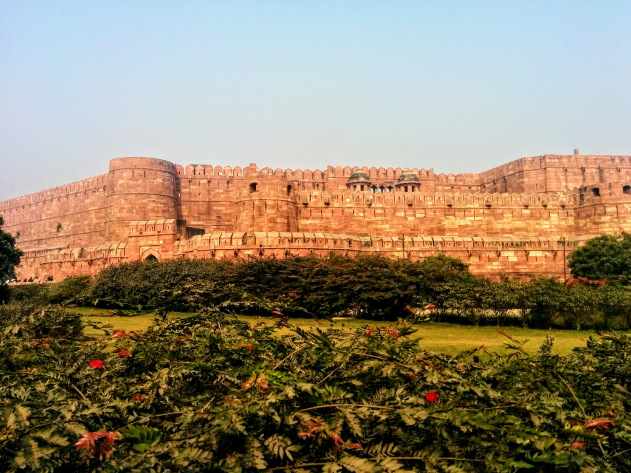
The mighty Red Fort of Agra

Right from the massively decorated entrance doors to the slow climb into the palaces and to the place where Shah Jahan used to live and watch the Taj Mahal, this place is full of historical wonders.

You have to see the Baby Taj
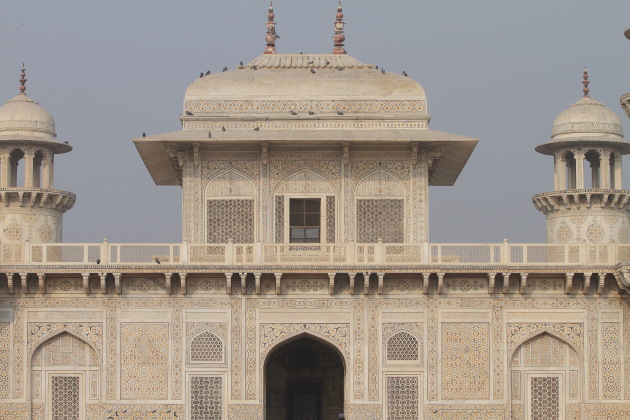
Intricate on the Baby Taj of Agra considered to be a smaller version of the Taj Mahal

Locally referred to as the Baby Taj, the Itmad-ud-Daulah tomb, located on the bank of the river Yamuna is a khazana of sorts. Built by Empress Nur Jehan (wife of Mughal Emperor Jehangir), for her father Ghias-ud-din-beg is possibly one of the prettiest tombs from the Mughal era.

Gorgeous carving and painting on the walls of Baby Taj, Agra, India

This is a perfect place to spend those late mornings or early part of the afternoon where you can enjoy its white marble, pietra dura, inlay work and amazing lattice work in a relaxed fashion.

Early Morning Visit to the 16th Century City of Victory

Durwaza of Itmad-ud-Daulah's Tomb or Baby Taj, Agra

An hour away from Agra, Fatehpur Sikri, was built by Akbar in the 16th century and it remained the capital of the Mughal empire for about 10 years. Surprisingly it was abandoned, but today, it exists as a UNESCO world heritage site that comprises of stunning entrance ways, well preserved palaces, one of the largest mosques in India and beautiful courtyards. Out of the two sunrises that you have, I would recommend one for the Taj Mahal and the other for Fatehpur Sikri.

Go for a Quiet Walk at Sikandra

Indo-Islamic architecture of Akbar's Tomb at Sikandra, Agra

If you feel like a good long walk amidst stunning red sandstone marvels in Agra, Akbar’s tomb at Sikandra should be one of the top options. Lush lawns with many grazing blackbucks, screeching parakeets and a secular campus, Akbar’s tomb, located in the center of this Sikandra garden is full of lovely nature and beautiful architecture.

Akbar's Tomb, Sikandra, Agra

Started by Akbar himself and completed by his son Jehangir, this place is full of marble tombs of Akbar’s family, colorful pathways and ceilings with inscriptions and a sense of calm in busy Agra.

Read a Book at any of Agra’s Off-Beat Parks

What a place to read a book - Taj Mahal in the background, Agra

Located enroute to Mehtab Bagh are many public parks that don’t hold any importance to the tourist, but I think that they are fantastic places to relax and read a book while watching locals and the Taj Mahal from a different perspective. These off-beat parks don’t charge any fee, are not crowded with tourists and offer a stunning view of the Taj.

Stunning view of the Taj Mahal, Agra, India

If you get lucky, you could even play a game of cricket with the locals at one of these parks.

Shopping Time

Entrance to Akbar's Tomb at Sikandra, Agra, India

While the days in Agra are usually spent in exploring its architectural marvels that stay open only till sunset, a good part of the evenings can be devoted to shopping. From souvenir shopping at Mughal Bazaar on Taj East Gate road to shopping for leather goods at Sadar Bazaar and from shopping for spices at Rawatpara market to specialized marble product shopping at Gokul Para near Raja Mandi, evenings at Agra can be spent quite fruitfully. Even if you don’t wish to buy anything, these places are full of color, vibrant mood and local flavor, thus offering a wholesome local experience.

Indulge in Chaats and Sweet Petha

Amazing intricate work everywhere inside Red Fort, Agra

A trip to Agra is not complete until you whet your palate with Agra’s iconic chaats and sweets. Starting with the spicy berahi to delicious samosa, kachori, Aloo-tikki, jalebis, paneer tikka and golgappa, Agra’s famous chaat items are available all across the town. You could either taste them while exploring the attractions of the city or during your evening shopping walks. And do remember to take some iconic petha back home as a souvenir. The best petha can be found at Hari Petha, Panchis, Bhimsain Baidyanath and the Pracheen Petha store. 

Where to Stay:

Carvings on the walls of the Red Fort, Agra

As most people who visit Agra wish to see the Taj Mahal, it is recommended that you stay close to the Taj. In fact, most of the hotel properties are located around the Taj. On my recent visit, I stayed at a homestay called Pearl of Taj, which is located near the quiet Taj East Gate.

How to Reach:

Rose ringed parakeets are omnipresent in and around Red Fort, Agra

Agra has an airport, but it is poor in terms of connections and tickets are more expensive than other cities. Delhi and Jaipur are possible airport alternatives. Delhi has more connections and Jaipur works out as a good low cost hub. Train connectivity for Agra is excellent. It has 2 train stations – Agra Cantt and Agra Fort. Do remember that while searching for trains. Road connectivity is also excellent, though during the winter months, foggy conditions can pose quite a problem.

Other Sightseeing Options:

A foggy view of the Yamuna river from one of the rooms in Agra Fort

If you have more than 48 hours in hand, you can choose from the following:

1) Birdwatching at Bharatpur Bird Sanctuary (60 kms frm Agra)

2) Wildlife Boat Safari at National Chambal Gharial Sanctuary (70 kms from Agra)

3) Temple towns of Mathura and Vrindavan (50 kms from Agra)

Continue Reading...

Monday, February 06, 2017

Pearl of Taj: Great Homestay real close to Taj Mahal, Agra

With the iconic Taj Mahal, 2 UNESCO world heritage sites in the Agra Fort and Fatehpur Sikri and many other stunning works of art and architecture, Agra is one of those cities in India that falls in the must-visit category. Personally, I love this city and have visited this city thrice (once each in the past three decades). My latest visit was during my recent winter holiday when I ended up staying for 3 nights at a homestay called the Pearl of Taj. The below review is based on this recent experience of mine. I am hoping that it will be helpful to all those of you planning an upcoming Agra holiday.

Hazy Taj Mahal view from Mehtab Bagh, Agra

1) The Pearl of Taj is located less than 10 minutes away from the East gate of the Taj Mahal and only about a 3 minutes walk to the ticket counter. The East gate is one of the quieter entrances to the Taj Mahal and hence sees relatively fewer people, fewer pestering street peddlers and shorter queues at the ticket booking counter. If the Taj Mahal is on your agenda, it doesn’t get any better from this. You can either walk from the hotel to the Taj Mahal or take a horse cart or battery operated car. Both the train stations of Agra are not too far away from this place.

2) The people running this homestay try to make you feel at home and are extremely helpful. They helped me fix date re-scheduling in spite of cleartrip not helping me on time, they helped with amazing local tips, guided me with proper directions and made sure that I was always welcome.

Akbar's Tomb as seen from the main durwaza entrance

3) Pearl of Taj is a cross between a homestay and a hotel. It is actually a home with about 6 or 8 rooms, but it has a full time front desk manager and room service personnel. So it kinda, provides the best of both worlds. The rooms do get a bit cold during the winter season and the ones with the balcony view are exposed to higher noise levels. So, it is recommended that you choose a room without a balcony view for a quieter stay. The rooms are quite big with modern amenities and a very comfortable hot shower.

4) A simple breakfast is included as part of your stay. For lunch, dinner and other meals, there is an adjoining restaurant that dishes out delicious food.

5) The Pearl of Taj homestay provides free wi-fi to all its guests and it is accessible all through the building.

Durwaza of Itmad-ud-Daulah's Tomb or Baby Taj, Agra

6) The homestay also has it own tour service for any of those interested. This includes exploring the popular and lesser known attractions of Agra in the company of a local knowledgeable guide. The best part is that the exploring is done in a military styled willys jeep.

If you are planning an upcoming holiday to Agra and looking for a comfortable place to stay that is located close to the Taj Mahal, I would recommend that you give Pearl of Taj a look in. It provides bang for the buck, larger size rooms and a cosy home environment.

Continue Reading...

Saturday, February 04, 2017

Travel Photo: A Different View of the Taj

The Taj Mahal is a stunning work of art and architecture. It does not matter when you look at it or where you look at it from, you still end up looking at it with awe and wonder. On my recent winter holiday, I returned to Agra to show my friend the Taj Mahal. Even though the Taj Mahal is stunning to look at from its premises or from across the river at Mehtab Bagh, there are so many non descript places spread across Agra from where one can enjoy the surreal view of the Taj without having to pay any entry fees or worrying about other security measures.

Gorgeous looking Taj Mahal from the other side of the Yamuna, Agra

Take this photograph as an example. This was taken from across the Yamuna and from inside a small public park where local kids played cricket or where local families spent their picnic. And the best part about this park was that it was totally clean making it a stunning location to catch a beautiful sunset shot of the Taj Mahal on non foggy days. Like this park, there are many places spread across Agra from where you can catch a glimpse of the majestic Taj Mahal. So, if you have a bit of time on hand and wish to take pictures of the Taj from different perspectives, then you should definitely visit such non-descript parks and locations across Agra.

Continue Reading...

Monday, October 26, 2009

Varanasi – the oldest living city in the world!!

Of days gone by...this March during my solo all India motorcycle journey

 
After exploring Taj Mahal and Agra over 3 days, I rode a long 650 km stretch in one day to reach the spiritual town of Varanasi (also known as Benaras and Kashi). As I entered the old town, I felt that I have landed in a different era. The retro style of building structure, thin lanes (galli’s), austerity and spirituality in the air just amazed me. This was my 2nd trip to Varanasi. The 1st one was way back in 1991 when I was a 10 year old. The city certainly had transformed over the years as other cities around the world, but in some way it had managed to retain its old world charm. I had a tough time finding myself a hotel as most of the hotels were afraid of admitting a sole dirty looking motorcyclist the day before the President of India landed at Varanasi. Finally, I found a person who was kind enough to direct me to a good hotel that was close to the Harishchandra ghat.


After freshening up, there were some things that I had to do first. First, taste the tea (chai) of Benaras offered in small earthen pots. Second, taste the thick curd (Indian Yoghurt) of Kashi offered again in earthen pots. Third, get my taste buds working over the famous Benarasi Paan. Varanasi, for a long time, is known for its famous thick milk and the ultimately popular Benarasi Paan. They are so popular that there is not a single adult male in Benaras who doesn’t chew and enjoy Benarasi Paan!! After satisfying my palate with specialities of Varanasi, I proceeded to the HarishChandra ghat, which is the only ghat on the River Ganges that has an electrical crematorium. It is believed that if one’s last rites are performed at Varanasi, then there is no re-birth and he attains moksha. After ambling around the ghat and watching the various rituals, I found myself a boatman and struck a deal with him to take me for an early morning boat cruise on the river Ganges. The deal was struck at Rs 600 for a 3 hour boat cruise.


It was an early wake up call for me and my boatman was waiting for me at the hotel reception. Off went both of us onto the River Ganges. The boat was a small 3/4 seater and it functioned using oars. With early sunrise, my boatman took me to all the ghats by the river ganga. It was during this cruise that I came to know about the hypothesis behind the name of this city ‘Varanasi’. The first hypothesis (which is wrong)says that the name of the first ghat is Vara and the name of the last ghat is Assi (meaning Eighty). The city that falls between these ghat extremities is known as Varanasi. The second and the more widely accepted hypothesis is that the city of Varanasi is located between two river confluences: one of Ganga and Varuna and other of Ganga and Assi.

During my cruise, I found out that the river bank by the various ghats is extremely dirty with muck, rotting offerings, flowers and rotting wood. A lot of activity is happening to prevent the Ganges from such pollution, but the onus of preventing the pollution rests with us tourists who are slowly destroying the Ganges in search of spiritual bliss. The river at Varanasi has already lost its prized denizen – the extremely endangered Gangetic dolphin. Even the more rugged mugger crocodile seems to have disappeared from here. And, now, even the locals and tourists avoid venturing into this side of the river bank. Rather, they go to the other bank like how I did to take the holy dip. After a refreshing holy dip in the Ganges, I went to a series of temples on different ghats (Shinde, Lalita, Bachraj, Mana-Mandir and Dashashwamedh) to admire their architecture and to offer my prayers. A pleasant sight to my eyes was scores of students learning and practicing yoga by the holy river against the early morning sun. Certainly, the brighter side of growing up in the ‘city of learning’.


It was post lunch, when I went to the famous Kashi Vishwanatha temple to offer my prayers. The entrance and the vicinity of the temple feels like a war zone as the entire area is always on high alert. There is checking every 10 feet. One can carry only some limited things into the temple. After offering my prayers to Lord Shiva, the presiding deity and Goddess Annapurna, I went to explore the colourful bazaars of the city. It was evening time when I went to Dashashwamedh ghat to watch the Aarti and the Agni Pooja (Worship to Fire). The entire river is resplendent with glittering diyas and it makes for a great sight.

It is certainly a revelation to watch this legendary city in its truest form and this quote by Mark Twain just adds to my belief": “Benares is older than history, older than tradition, older even than legend, and looks twice as old as all of them put together.”

Continue Reading...
Logo Credits : Jobi T Chacko. UI/UX Credits : Murugan S Thirumalai
Copyright © 2009-2026 Sankara Subramanian C (www.beontheroad.com)
Reproduction without explicit permission is prohibited. All Rights Reserved

Join the Travel Club for FREE!!
and every fortnight get in your inbox...interesting experiential and off-beat travel stories , destination guides, handy tips (travel, photography and visa) based on personal experience, global vegetarian delights with helpful survival guides and gorgeous world travel images and videos as I (the Indian traveler) trot the globe! And a lot of other travel invites and soon to be launched goodies !

* indicates required
Close