Samburu National Reserve - Be On The Road | Live your Travel Dream!
none

Tuesday, April 05, 2022

The Colourful Samburu Tribe of Kenya: A Travel Photo Series
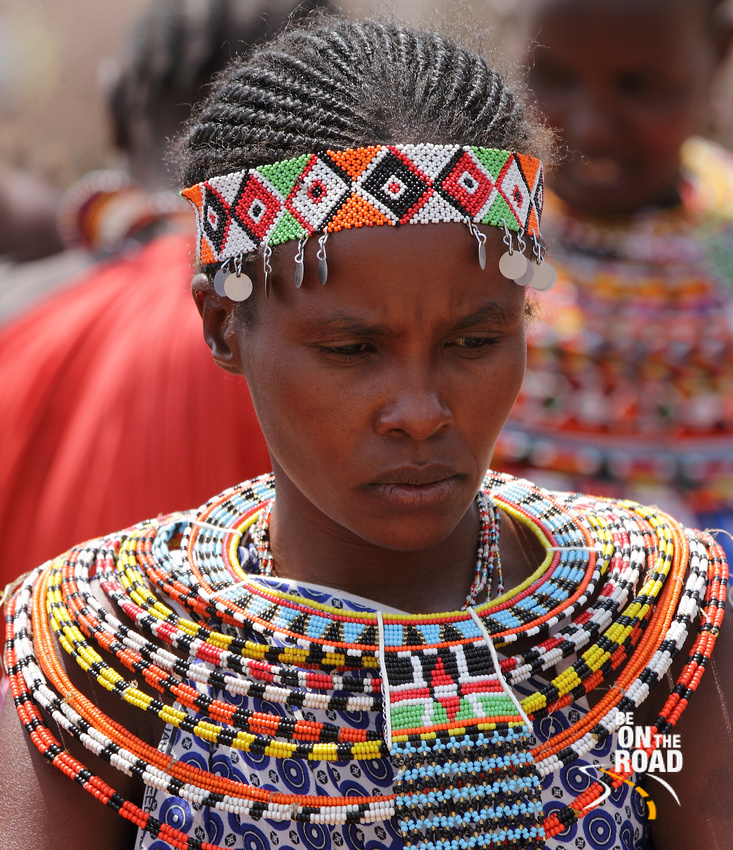
A Beadwork Samburu Model, Kenya

They are related to the famous Maasai tribe living in the Maasai Mara game reserve in Kenya. They are one of the more dominating tribes of north-central Kenya. They are semi-nomadic pastoralists who mainly herd cattle, but also keep sheep, goats and camels. I am talking about the colourful Samburu tribe who live north of the equator in Kenya and live in very diverse and beautiful landscapes that span high altitude forests, open plains, semi-arid grass and bush land to complete desert. One of their main settlements is on the fringes of Samburu National Park in North Kenya and this is where I met them. Experiencing the Samburu National reserve and the Samburu tribe becomes a beautiful one-two combo for a rich wildlife and culture experience.

This travel photo series aims to share with you the colourful personalities and traditional life of the beautiful Samburu tribal people. Hope you enjoy these vibrant visuals of these gorgeous tribal people of Kenya.

Above picture: The Samburu tribe is known for its colourful beadwork jewellery. Here you can see a Samburu woman wearing such colourful head and neck bead jewellery.

A Portrait of a Samburu Man

Above picture: Samburu men also adorn themselves with such colourful bead jewellery making them fantastic looking male models too.

Exquisite bead work on this Samburu woman

Above picture: Here is another Samburu tribal woman sporting colourful beadwork necklace, ear rings and head gear. The concentric rings on the necklace makes her look similar to the long necked Karen tribal women of Myanmar, but thankfully their necks have not been lengthened.

This game played with seeds and compartments is only played by the elderly men of the Samburu tribe

Above picture: Seen in this photo is a game with seeds and compartments played only by the elderly men of the Samburu tribe. This game is very similar to Pallanguzhi, a traditional ancient mancala game played in South India, especially Tamil Nadu and Kerala.

A rich dash of colour on all the Samburu women

Above picture: It is said that the more beads or necklaces are there on a woman, the more beautiful she is considered. Another point on the same line of thought is that, women wore more necklaces as they got richer. Therefore, the number of beads or necklaces indicate status in society, richness level and beauty.

Inquisitive Samburu looks

Above picture: The Samburu people speak the Samburu language, which is a Nilo-Saharan language. Their language is more or less similar to Maa (the language that the Maasai speak). The Samburu tongue is also related to Turkana and Karamojong and more distantly to Pokot and the Kalenjin languages.

Young Samburu Kids strike different poses

Above picture: Like all kids, the Samburu kids are also full of energy and innocent smiles. They can be seen wearing Western attire.

Samburu Elders huddle together under a tree to play a game

Above picture: The elders occupy a very important role in the Samburu society and all the power rests with them. They have a polygamous system where the elders decide who can marry and can have how many wives. This kind of control keeps trouble at rest or at least that is the belief.

The Samburu Warriors strike a pose

Above picture: In the Samburu tribe, the men take care of security, cattle herding and playing mock fight games to improve their warrior skills.

The colourfully decked Samburu tribals

Above picture: While the Samburu women take care of things like building houses, collecting firewood and food from the forest, cooking food, taking care of the young ones and in doing craftsmanship.

Wedding dance enacted by the Samburu men and women

Above picture: The Samburu love to sing and dance, but traditionally use no instruments. They have dances for various occasions of life. The men dance jumping and high jumping from a standing position is a great sport. Most dances involve the men and the women dancing in their separate circles with particular moves for each sex, but coordinating the moves of the two groups. A lot of their dances involve elaborate movements of their chest.

A Mean Samburu Warrior look

Above picture: Girls get married pretty early. Sometimes before they turn 18. Both boys and girls go through an initiation into adulthood, which involves training in adult responsibilities and circumcision for boys and clitoridectomy for girls. Ouch!

Samburu Women welcome the tourists into their village

Above picture: If you wish to marry a Samburu woman, all you have to do is give the chief of the village 2 cows. That is how weddings happen in the Samburu culture.

Women work much harder than the men in the Samburu community

Above picture: The hard working Samburu woman. She works in the forest, inside the house and in the manyatta or settlement.

A Samburu house made from wood, mud and plastic (for the roofing)

Above picture: A typical Samburu house is built by the wives of that house using sticks, mud, dung and plastic (for waterproofing).

Continue Reading...

Tuesday, April 02, 2019

Kenya’s Samburu National Reserve: A Photo Story of Wild Riches

Beisa Oryx horns in perfect symmetry

Africa is the place to go for that ultimate wildlife experience. While Maasai Mara, Kruger National Park, Okavango Delta, Bwindi Impenetrable National Park, Etosha National Park and Serengeti National Park are considered the best safari parks in Africa, there are so many lesser known places where one can have an absolutely amazing wildlife holiday.

Samburu National Reserve, located in the northern part of Kenya is one such mesmerizing and rich wildlife zone in Eastern Africa. Not only does this place allow you to see amazing African wildlife, but it also allows you to experience one of Kenya’s colorful tribes. Usually, visitors to Kenya explore Lake Naivasha, Lake Nakuru, Maasai Mara, Amboseli National Park and the country’s East Coast, but if you have some time on hand, head north towards Lake Turkana (near the Somalia border) and enroute visit Samburu National Reserve for a landscape full of wild riches.

From the big five to muscular antelopes and from colorful birds to dazzling primates, Samburu has it all. Here is a photo story of the wild riches of this place from my last visit there. I hope these pictures give you ideas for a surreal wildlife holiday to Kenya.

Above photo: The gorgeous Beisa Oryx, a large antelope, is big, has beautiful stripes and has eye catching horns.

Eastern Yellow Billed Hornbill

Above photo: A Eastern yellow billed hornbill sitting on a fruit tree. These birds love their fruits and are an essential cog in maintaining the health of the forests.

A muscular gerenuk feeds while standing on its hind legs

Above photo: The gerenuk, another large and muscular antelope loves to stand on its hind legs to reach the juicy shoots on small desert shrubs and trees.

Beautiful Vulturine Guineafowl flapping its wings

Above photo: The cobalt blue Vulturine guineafowl is in my opinion one of the prettiest large birds of Africa.

Elephants of Samburu National Reserve

Above photo: A small herd of African elephants in monochrome. Both the male and the female elephants have tusks unlike the Asian elephants where only the males have tusks.

D'Arnaud's Barbet shining in the afternoon sun at Samburu National Reserve

Above photo: The D’Arnaud’s barbet is a very pretty bird that can be seen in shrubs and bushes, especially close to human civilization.

Kirk's Dik Dik - a very small antelope

Above photo: The Kirk’s Dik Dik is one of the smallest antelopes of Africa.

Crested Francolin

Above photo: The beautifully patterned crested francolin on the floor of the Samburu forest.

Leopard stares on into the woods

Above photo: The spotted leopard is may be keeping an eye on its prey.

Reticulated Giraffe crosses the jeep track at Samburu National Reserve, North Kenya

Above photo: The reticulated giraffe (one of the 3 types of giraffe found in Kenya) crosses the jeep track.

Crested Bustard

Above photo: The crested bustard, a flightless bird found in drier regions of Kenya.

A large male olive baboon

Above photo: The antics of the usually rowdy and rough olive baboon.

Yellow-necked Spurfowl on top of a bush at Samburu National Reserve

Above photo: The vividly colorful yellow necked spurfowl on top of a small plant.

A mother and baby elephant at Samburu

Above photo: A female African elephant and her young one.

Superb Starling - a stunning bird common in Samburu National Reserve

Above photo: The metallic blue Superb Starling is superb indeed!

Black Faced Vervet Monkey at Samburu National Reserve

Above photo: The black faced velvet monkey chomping on some grass from the floor of the Samburu forest.

Grey Headed Kingfisher

Above photo: The grey headed kingfisher found close to the Ewaso Ngiro river inside Samburu National Reserve.

Impala - a very pretty antelope looking out for danger at Samburu National Reserve

Above photo: The pretty Impala antelope looking out for danger.

The sharp horns of Beisa Oryx

Above photo: You definitely want to stay far away from the sharp horns of the Beisa Oryx antelope.

Grant's gazelle

Above photo: The Grant’s gazelle, one of the many types of antelopes seen at Samburu National Reserve.

The Beautiful Grey-crowned Crane from the Samburu National Reserve

Above photo: The grey crowned crane, another beautiful bird found in Kenya.

Grey Headed Kingfisher and an elephant trunk in close action

Above photo: The grey headed kingfisher stays steady in spite of the elephant trunk disturbing the branches it is sitting on.

An elephant watches a safari vehicle go by

Above photo: The African elephant raises a trumpet warning call upon approach of a jeep.

A cheetah resting in the shade at Samburu

Above photo: A Cheetah lazily looks up from under a tree, where it is taking its afternoon nap.

A Samburu lioness

Above photo: A lioness resting in the shade during mid day.

Martial Eagle

Above photo:
The Martian Eagle, a beautiful raptor seen at Samburu National Reserve.

Continue Reading...

Wednesday, January 27, 2016

Travel Photo of the Day: Samburu Tribals of North Kenya

Samburu Tribal Woman, North Kenya, Africa

Considered as cousins of the Maasai tribe, the Samburu tribals are found in the northern part of Kenya and Southern Somalia. Located in this arid region, I spent time interacting with them both at Lake Turkana and at Samburu Game Reserve. Like most people located in dull surroundings, this tribe too dons a lot of color. And this applies more to their women. I absolutely loved their colorful jewellery and how nicely it filled the frames of my photograph. 

Note: Click on the photo to share it or to download a higher resolution as your desktop wallpaper.

Continue Reading...

Tuesday, November 20, 2012

Samburu National Reserve: An Oasis of Wildlife in Arid North Kenya

Remote, thinly inhabited and practically unknown to outsiders, Northern Kenya is one of Africa’s last great wilderness areas. While the Lake Turkana and the Chalbi desert are areas that even the locals have not visited, there lies a belt in Northern Kenya that is fiercely popular with locals and tourists alike.

A Baby Elephant protected by the larger ones
That stretch is the Samburu National Reserve that is situated near Isiolo and offers exceptional wildlife viewing. Samburu is an unfenced reserve that protects semiarid savannah land flanking the Ewaso Nyiro river. It’s ecology is defined by the contrasting habitats of riverine forest along the Ewaso Nyiro and austere acacia scrub and rocky slopes extending from it.

Milestone Marker at the entrance to Samburu National Reserve
This reserve along with the neighboring Buffalo Springs reserve (that is currently inaccessible due to a broken bridge) probably offers the best chance of sighting the leopard in Kenya, and lion, elephant and buffalo are also quite common. The main attraction, however, is a host of dry country specials absent or rare in most other East African parks.

Beautiful Vulturine Guineafowl flapping its wings
This includes mammals such as Beisa Oryx, Grevy’s Zebra and Gerenuk, and a long list of birds of which the cobalt-chested vulturine guinea fowl is the most spectacular. The star attraction is however the Grevy’s zebra, which is larger than the more widespread plains zebra and with a narrower stripe pattern. This endangered species is more or less endemic to North Kenya. I tried hard to spot this beautiful mammal, but luck was not on my side on those game drives.

Impala
The Samburu landscape is dominated by the Ewaso Nyiro river, a place around which most of the wildlife action happens especially with the elephants and the crocodiles. This river rises in the Aberdare mountains and arcs through the Laikipia plateau before eventually emptying into the expansive Lorian Swamp in Kenya’s remote northeast.

The Doum Palms such as this dot the Samburu landscape
Although it has been known to cease flowing in the dry years, the river is essentially perennial and its name, which means muddy water or brown water, refers to the rich red-brown top soil it carries down from Laikipia.

Kirk's Dik Dik - a very small antelope
Within the reserve, the river supports a lush ribbon of palm studded riparian forest that contrasts pleasingly with the surrounding aridity. The jeep tracks that run parallel to both the north and south banks offer the best wildlife sighting opportunities during game drives.

A cheetah resting in the shade at Samburu
Hippo and crocodile are resident and easily seen as are a host of water associated birds like fishing eagles, kingfishers and spoonbills. The riverine vegetation also attracts plenty of elephant and buffalo. The reticulated giraffe is also seen close by.

Leopard stares on into the woods
The other special area in Samburu National Reserve is the Ol Doinyo Koitogorr, a 4,100 feet high mountain that supports a tangled cover of dry thorn scrub dominated by stunted acacia trees. It is on these acacia trees that the buffalo weaver and the sparrow weavers build innumerable nests.

A large male olive baboon
Wildlife concentrations are lower away from the river, but one can spot some unique species here. Like the rubber-necked gerenuk that can be seen in family parties foraging on acacia canopies. The dik diks and larger antelopes such as the eland, impala, lesser kudu and Grant’s gazelle are also very visible.

Secretary Bird
This northern scrubland is especially rewarding for birders who are on the lookout for dry country birds such as vulturine guineafowl, yellow throated spurfowl, blue legged Somali ostrich, Egyptian vulture, golden pipit, golden-breasted starling, black capped social weaver, white-headed mousebird, Somali bee-eater, bristle-crowned starling and more.

It was so difficult to capture the full body of the giraffe in my long zoom lens. They are so huge!!
Personally, I loved the wildlife experience that Samburu offered to me during my 4 game drives here. In my mind, it is possibly the prettiest wildlife reserve in Kenya and the most interesting part of this forest is the rich abundance of birds in spite of most the terrain being semi arid.

Eastern Yellow-billed Hornbill at Samburu National Reserve, North KenyaSeeing a rich haul of hornbills here was the main highlight. This is one place that you should try and add to your Kenya Wildlife itinerary that I am sure includes Maasai Mara, Amboseli, Nakuru and Tsavo.

The entrance gate to Samburu National Reserve in North Kenya
Distance from Nairobi: 400kms or 6-7 hours by road. Nanyuki can offer a short, yet entertaining pit stop.

Continue Reading...
Logo Credits : Jobi T Chacko. UI/UX Credits : Murugan S Thirumalai
Copyright © 2009-2026 Sankara Subramanian C (www.beontheroad.com)
Reproduction without explicit permission is prohibited. All Rights Reserved

Join the Travel Club for FREE!!
and every fortnight get in your inbox...interesting experiential and off-beat travel stories , destination guides, handy tips (travel, photography and visa) based on personal experience, global vegetarian delights with helpful survival guides and gorgeous world travel images and videos as I (the Indian traveler) trot the globe! And a lot of other travel invites and soon to be launched goodies !

* indicates required
Close