Uttarakhand - Be On The Road | Live your Travel Dream!
none

Friday, May 29, 2020

5 Best Treks For Beginners In Uttarakhand

Best Treks for Beginners in Uttarakhand

In all probability, you might have heard of the iconic band 'The Beatles' and even heard their music. But you might be surprised to know they visited Uttarakhand, dubbed as the 'Land of God', to find some creative inspiration!

Well, it is not tough to gauge why they conceived Uttarakhand as a source to get their creative juices flowing. The sprawling Himalayas, dense wood, whirlwind of flora and fauna, and lastly, the treks, everything for you to delve into your creative perfection away from the noise.

Hill stations like Nainital, Mussoorie, Auli and Dehradun have always been pulling in people across the globe. The trekking enthusiasts have more reasons to visit Uttarakhand as the trails of some of the famous treks lead to this place.

We will be talking about some of them today.

1) Nag Tibba - Appreciate Nature’s Mastery

Sunset from Nag Tibba trek

Best time to visit:
Winters - October to December / Summer - April to June

Duration of Trek: 7 hours for a 10 km trek from the base camp to the hilltop

Level of difficulty: Relatively easy

Each trek takes hours of effort to get a sight of nature's brilliance forming indelible moments. Nag Tibba provides sight of nature’s mastery, but with minimum sweat work. It is an ideal weekend trek that can aptly compensate for the Himalayan trek you have been planning for months.

The trail cuts its way through the grass cover, dense jungle and heritage sites. Thus, all the way, you have something pushing you forward when you are exhausted. At the top, you have the prize waiting, a 100-degree view of the snow-capped Himalayan range, Bandarpoonch and Kala Nag peak. The sight of
Kedarnath peak in the North would itself be the sole motivator of the trek.

2) Har Ki Doon - Encounter Rare Fauna and Floor

Har Ki Doon Trek, Uttarakhand

Best time to visit:
Summer - April to June / Autumn - September to December.

Duration of Trek: Total 47 km can be covered in 6-7 days.

Level of difficulty: Moderately difficult

This trek is a part of a common folklore tale and stretches over 44 km. The highest point in the trek stands at 14,000 ft. The mesmerising views of the nearby mountain ranges in both summers and winters are a sight to behold.

The beauty of Har Ki Dun trek lies not just at the summit, the trail itself takes you through a journey in time with small settlements formed a hundred or even some thousand years ago. Amidst the woods, you might find some rare avian life along with other forms of wildlife.

This place is known for its frequent rains and most of it is concentrated in summers. The hide and seek between the sun and rain-filled clouds ready to burst make the trek even more satisfactory. But you must be properly equipped to tackle such situations.

3) Valley of Flowers – Trek amidst Nature’s Vibrant Colors

Scenic treks of Uttarakhand

Best time to visit:
July to August, the time when the flowers are in full bloom

Duration of Trek: About 6 days to complete the trek

Level of difficulty: Easy to Moderate

Close your eyes and imagine yourself standing amid more than 600 floral species, surrounded by tall mountains. Welcome, you are in a Valley of Flowers, as listed in UNESCO world heritage sites.

This place is a paradise for people who are enthralled by nature and love flowers. Not just the floral life form that is enticing here, a few kilometers into the wood and you might spot a musk deer, black bears of Asian origin, blue sheep and many other wildlife species.

As a tourer, you will find many reasons that prove why this place is listed in the UNESCO records.

4) Auli – Winter Trekking Destination

Those snow capped mountain views during a trek in Uttarakhand

Best time to visit:
November to March

Duration of Trek: 3 hours, covering 5-6 km

Level of difficulty: Moderately difficult

Auli is one of the most perfect winter destinations, away from rising mercury of the urban chaos. Trekking in Auli has the ideal mix of leisure and adventure. Such combination results from the lush green valley and snow-covered mountains that follow you throughout the trail.

Auli is one of the ideal places for a snow trekking adventure. It cultivates a sense of joy when you see snow all around you, much like a kid in a candy store. The sight of sunrise and sunset can turn anyone into a photographer.

As you complete the trek, a 360-degree view of Garhwal Himalayas and Nand Devi awaits you.

5) Kedarkantha Trek - Amidst Snow Covered Trails
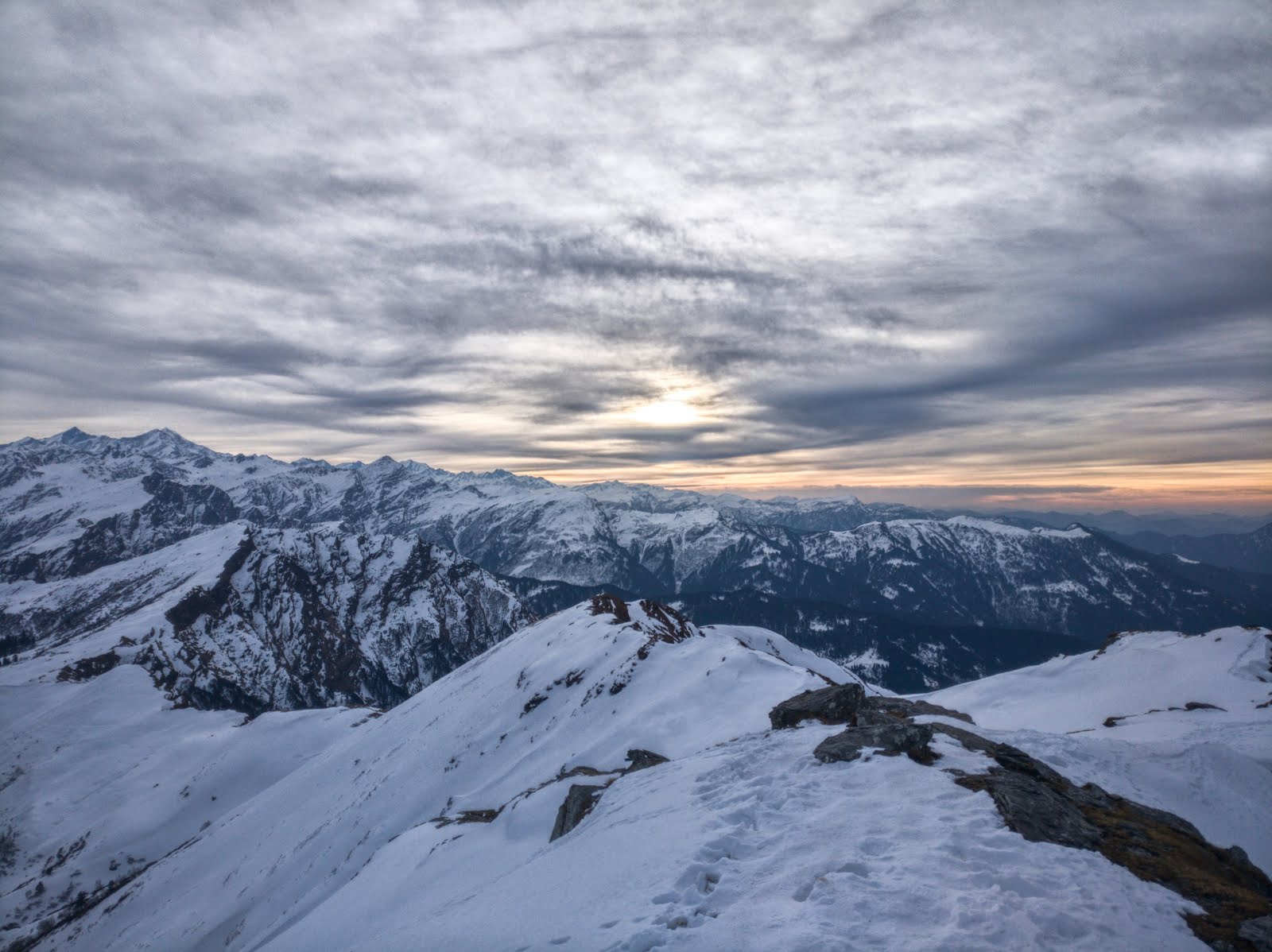
Skyscape from Kedarkantha Trek, Uttarakhand

Best time to visit:
Winter - December-to-March.

Duration of Trek: 7 hours to complete the trek of 6 km

Level of difficulty: Easy-to-moderate

You might not be an expert trekker to take on hard terrain all the time, but if you want to be a part of such a pre trekking destination, the Kedarnatha trek is your place. The snow-covered trail shows you the path right to the summit. The surrounding view of the snow-covered Black peak, Bandarpoonch and Swargarohini mountain range will allure you to move forward.

The campsites are sporadic and consistent. Thus at any point in your journey, there is a campsite just a few kilometers away. These campsites would provide you the much-needed rest after long hours of trek and get your body ready for the upcoming trails.

Closing thoughts

Beginning the descent after soaking in the snow capped mountain views

In a nutshell, Uttarakhand has the trails to suit all forms of trekking enthusiasts. You just need to unpack apprehensions and dive into the adventure. You have parks, snow covered mountain ranges and rich flora and fauna reserves to keep you at your toes.

AUTHOR BIO: Amit is an avid traveler and passionate writer. His weekends are dedicated to travel and free time dedicated to writing for his blog www.realbharat.org. His passion for both these hobbies made him start realbharat.org. The blog is intended to bring out the real India and present it to the world!

All the photographs in this article are courtesy of the author.

Continue Reading...

Wednesday, July 25, 2018

12 Stimulating Sights of Rupin Pass Trek

Rupin River, the main path of the Rupin Pass Trek

The week long Rupin Pass Trek in Himachal Pradesh offers changing scenery almost on a half day basis. It boasts of being among the top 10 Indian Treks. Full of adventure and surprises, this hike keeps you anticipating what follows next.

This is a moderately difficult trek. The route is patched with scree, snow, swampy ground, moraines, sharp ascent, and descent. To enjoy the amazing sights, you need to be an experienced trekker with good cardiac stamina. Else, the terrain can take a physical and mental toll on you.

Colorful flowers seen during Rupin Pass Trek

The journey begins from Dhaula Village (5,100 ft.) in Uttarakhand and ends at Sangla Kanda Village (8,900 ft.) in Himachal Pradesh. Here are some spectaculars you will find in your journey in the order of beginning to end:

River Rupin:
Gushing over the bed of rocks and boulders, this beautiful river stays with you near or far until the Upper Waterfall Camp on day six. As you trek towards Sewa Village on day two, just around half an hour out of Dhaula, you see a full stretch of River Rupin flowing below in the green valley. Looking down from that height it makes for a picture perfect scenery. The river culminates in the legendary, high-altitude 3-fold Rupin waterfall.

Sewa Temple:
Sewa owes its identity to an ancient Lord Shiva Temple, which is opened just once in 12 years. This wooden temple’s architecture has typical Kinnaur influence. The double storied building is like a clock tower or light house in shape with slanting mountain style thatched slope top. It stands tall amidst wheat fields and apple orchards. You fix your first camp at this very fascinating Sewa village (6,300 ft.).

The 2 States:
On day three en route to Jhaka, you cross an old log bridge over a fast flowing Rupin stream. And you won’t believe that in traversing that bridge, you crossed from Uttarakhand to Himachal Pradesh. Yes! This dilapidated wooden bridge connects the two states!

Hanging Village seen during Rupin Pass Trek

Hanging Village:
The same day you climb to the Hanging Village of Jhaka (8,700 ft.). A difficult day, but totally worth it. Towards the end of the hike you pass through thick forest of deodar and walnut. As you hike further you will see village huts dotted over the slope’s edge in an incline. The whole hamlet looks suspended on the hill side and so the name. Even the guest houses and home stays have balconies resting at the border of the cliffs!

Forests:
Days 2-4 of the trek involve cruising through beautiful thick forests of Pine, Deodar, Fir, and Walnut with over 100 foot-tall trees. Some woods even host you with several streams and waterfalls.

Burans Kandi Meadows - Rupin Pass Trek

Buras Kandi and Saruwas Thatch (11,150 ft.) Meadows:
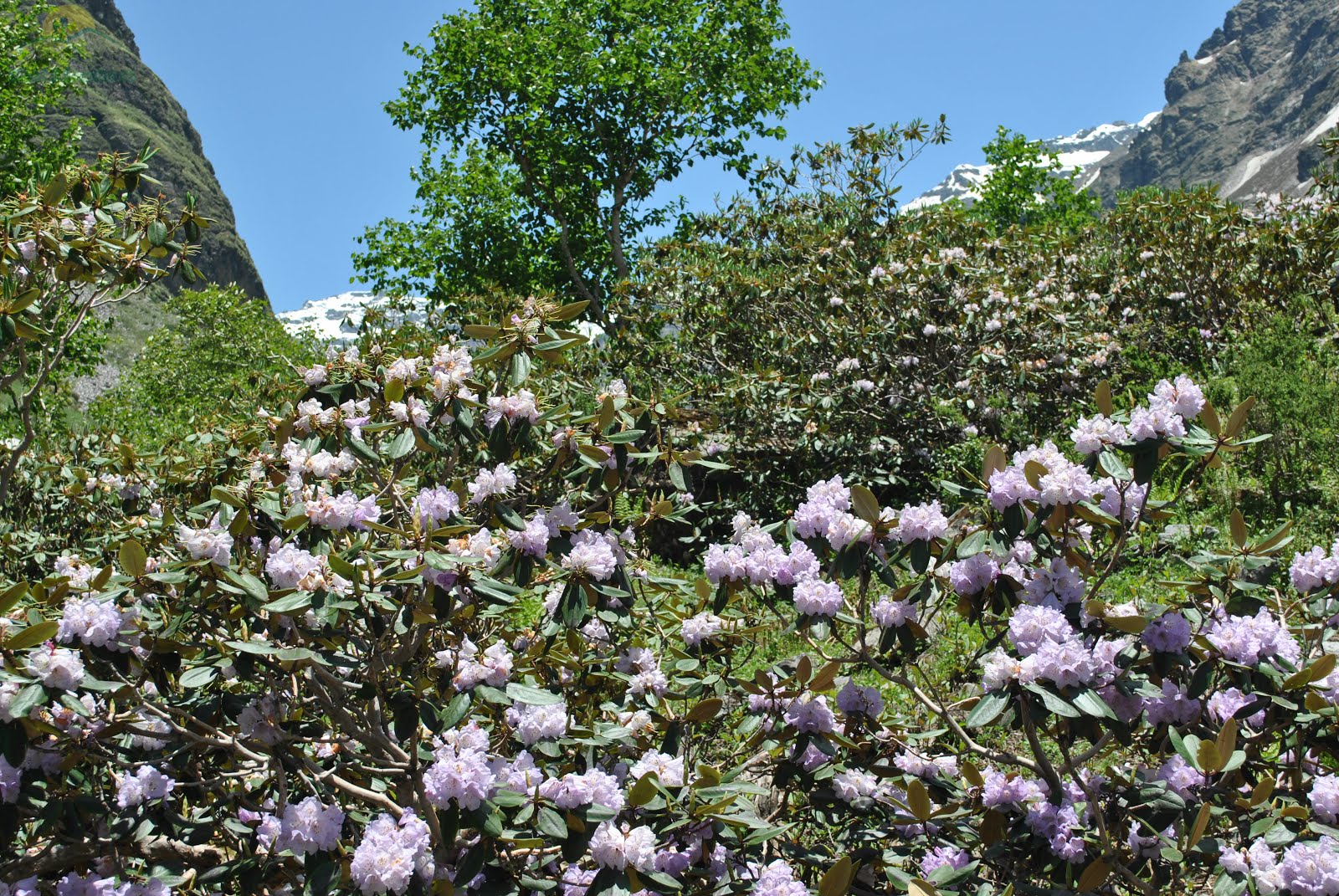
On day four, as you set out for Saruwas Thatch, past Buras Kandi, you reach an incredible meadow with multi-colored rhododendrons adding vibrancy against the green mountains. River Rupin flows nearby. As you reach the Saruwas Thatch Camp you are standing again among velvety green, majestic mountains on lush grassland with yellow wild flowers contrasting it.

Waterfall seen during Rupin Pass Trek

Rupin Waterfall:
Rupin Waterfall is spotted in May-June and in September-October. That’s also the time to trek in the region. The waterfall thunderously flows from a height of over 1,500 ft. in three levels according to visibility – upper, middle, and lower. You get the first glimpse of lower waterfall on day five as you trek for Dhanderas Thatch Camp (11, 680 ft.). On day six, you climb to Upper Waterfall Camp (13,120 ft.) and you see a massive Rupin River falling down in full force as a raging waterfall from the middle of the lush green grassy mountain slopes. The view is just spectacular!

Glacial Valley Meadow:
See the beautiful glacial valley meadows on day four when hiking for Saruwas Thatch.

Snowfield seen during Rupin Pass Trek

Snow:
This trek gives you snow in full measure. On day five, you negotiate over natural snow bridges when heading for lower waterfall at Dhanderas Thatch Camp! Stretched through the valley, the frozen rivers help you cross the flowing river underneath. You also see a lot of snow slopes here. And the sense of adventure that brought you here in the first place pulls you in to glide down them. Cross three waterfalls to reach very splendid and amazing snow fields on day six at the Upper Waterfall Camp. They are vast stretches of snow with several river streams passively running across the white basin. Black mountains around add to the contrast.

Rupin Pass Trek, Himachal Pradesh

Rupin Pass (15,380 ft.):
You traverse through Rupin Pass Gully to reach Rupin Pass. The climb and deep snow make the stretch arduous as well as interesting. You get to spend just 15-20 minutes at the saddle shaped Pass, from where you see massive mountains all around, including Dhauladhar and Kinnaur Kailash Ranges. You come sliding down from the Pass to descend, which is pure unadulterated fun.

Kinnaur Kailash Range:
On the last day of the trek (day eight), you lose height quickly due to steep descent. On your way down, you see Kinnaur Kailash Range standing tall in front of you. The trek ends as you reach Sangla Kanda.

Note: All the photographs in this article are copyright of Bikat Adventures and used here with their explicit permission.

Continue Reading...

Sunday, October 25, 2009

Corbett Tiger Reserve – India’s First National Park

Of days gone by...this March during my solo all India motorcycle journey

 
Jim Corbett National Park is located in the Ramganga valley near the Himalayan foothills. Nestling in the foothills of the mighty Himalaya, Corbett tiger reserve lies mainly in the hilly districts of Nainital, Almora and Pauri Garhwal. This present 1318.54 sq km tiger reserve was established in 1936 when Governor Malcolm Hailey created India’s first and (the world’s third) National Park. The terrain is hilly, ranging from 600-1,100m above sea level, consisting of mixed deciduous forests of sal and sheesham trees and the ubiquitous lantana bush, and open, grassy pastures known as chaurs. The chaurs make up around one-tenth of the core area and make ideal grazing ground for the park’s large population of wild elephants. The park is home to around 580 bird species, 50 mammals, and at least 25 reptile species, including the Indian python, cobra and krait.


After following the rivers Yamuna and Ganges in Uttarakhand for more than a week, I made my way to the Corbett Tiger Reserve. I reached Corbett Tiger Reserve after crossing the spiritual towns of Rishikesh and Haridwar and after a brief lunch stop at IIIT Roorkee to meet my fellow wildlife enthusiast friend. As soon as I reached Ramnagar, I checked into a hotel on the main market road and headed towards the forest department office to book my accommodation and hire a gypsy.


The idea was to book my accommodation at the Dhikala Forest Rest House, which is right in the middle of the Corbett Tiger Reserve, about 50 kms from the town of Ramnagar. The Dhikala Forest Rest House is situated at a slight altitude beside the Ramganga river and offers luxury and budget accommodation to tourists in an enclosed compound. Accommodation costs start from Rs 150/night for the dormitory to Rs 2,500 for the palatial bungalows. Bookings can be made either online or at the respective Corbett forest booking centres at Ramnagar and at other nearby centers. Per day cost for a gypsy (open jeep) varies from Rs. 2,000 to Rs. 5,000 for 24 hours depending on the tourist and holiday season. The gypsy will start from Ramnagar at 1 pm, provide a tour of the Corbett Tiger reserve and stay with the tourist through the night at the Dhikala forest rest house. They will then provide us 2 safaris during the day. Though, it is mainly one good wildlife safari during the morning hour and one so-so safari during the later half of the morning. Finally, they drop the tourist at Ramnagar by 1 pm. Apart from these, the tourist has to bear some entry costs that include entry for the tourist party, entry fees for the camera and video camera, entry fees for the driver and forest guide fees.


The Corbett tiger reserve is bisected by the Ramganga river, running broadly south-south west, and the Kosi rover, and their many tributaries. The park also encompasses the Kalagarh dam, where the Ramganga creates a large reservoir – a great attraction for the many species of migratory birds that flock here during the winter months. The rivers are populated with Mahseer and other fish, which support a variety of aquatic and water-side life, including gharial and mugger crocodiles.


Corbett Tiger Reserve has tow main tourist zones. To the south-east, nearest to Ramnagar, is the smaller portion called the Bijrani range (entry through Amdanda gate). This area is preferred for day trips and makes for excellent wildlife tracking by jeep. The other, much larger, range is collectively referred to as Dhikala. Entry here is through the Dhangari gate and is restricted to those who have a permit to stay overnight in any one of the five  Forest Rest Houses within this section of the park. Each of these rest houses have superb locations – Dhikala being the largest and the most popular, sited by the reservoir of the Ramganga river which in turn is surrounded by vast grasslands.


The gypsy drive from Ramnagar to Dhikala offers great sights. The entire route is made up of dense green cover and there are these small, but bad stretches of road that are damaged every year by the overflowing tributaries of the Ramganga and the Kosi rivers. The entire drive from the Dhangari gate to the Dhikala forest rest house provided me with sightings of spotted deer, sambar deer, barking deer and a lot of terrestrial birds. The entire place is so picturesque.


Upon reaching the Dhikala Forest rest house, I went about exploring the wired enclosure, the various accommodation options and the nearby wildlife. There are a couple of options to dine here. One at the main restaurant, which is slightly pricey or at the forest canteen which offers decent food for an affordable price. Bonnet macaques and common langaurs throng this place as they would in forests anywhere else in India. I got great views of large herds of spotted deer and wild boar grazing by the banks of the Ramganga. Grey hornbills and purple sunbird were spotted by me in plenty during the late hours of the evening.


It was post sunset that I befriended a lot of groups here. A couple of avid birdwatchers and wildlife enthusiasts, a family from Jamshedpur who were related to my 1st standard class teacher and a couple from Mumbai who were professors in IIT Mumbai. The family from Jamshedpur were very kind to treat me to dinner at the forest canteen. It was late in the night that I spotted a small group of spotted deer that had come to graze in front of my dormitory.


It was early next morning, when we left for the wildlife safari. We diligently followed the signs of the tiger and even heard a lot of alarm calls go by, but were unlucky not to spot one. However, having said that, the wildlife experience was not bad at all. In fact, it was a rich wildlife catch for my eyes and my lens.


Following were the mammals and reptiles that I sighted at Corbett Tiger Reserve: Gharial, Barking deer, Spotted Deer, Sambar Deer, Wild Boar, Common Mongoose and the Great Asian Elephant.


Following is my rich bird sighting at the Corbett Tiger Reserve: Indian Grey Hornbill, Red Vented Bulbul, White Eared Bulbul, Spotted Dove, Common Myna, Purple Sunbird, Indian Pond Heron, Common House Crow, Pied Bushchat, Common Stonechat, Crested Serpent Eagle, White-necked Stork, Black Shouldered Kite, Lesser Spotted Eagle, Greater Grey-Headed Fish Eagle, Grey Jungle Fowl, Red Jungle Fowl, Indian Peafowl, Grey Francolin, Black Francolin, Rose-ringed Parakeet, Plum headed parakeet, Lesser Coucal, Brown Fish Owl, Small Blue Kingfisher, White Breasted Kingfisher, Indian Roller, Small Green Bee Eater, Blue-Bearded Bee-Eater, Little Scaly-Bellied Green Woodpecker, Small Yellow Naped Woodpecker, Rufuous-backed Shrike, Bay-backed Shrike, Black Drongo, Pied Fly Catcher Shrike, Rufuous Bellied Babbler, White-throated Fantail Flycatcher, Blue Whistling Thrush, Tickell’s Flowerpecker, Small Sunbird and Crested Bunting.

The wildlife is so rich here, that I would always grab an opportunity to visit the Corbett Tiger Reserve with or without a tiger sighting!!

To see India through the eyes of a motorcyclist’s lens, visit the album below.

my solo all-india motorcycle journey


Continue Reading...

Global Warming changing the climate pattern in the Himalayas!!

Of days gone by...this February during my solo all India motorcycle journey

I was at Mussoorie, the pretty hill station of Uttarakhand that is located on the Garhwal hills. A 34 km winding ride from Dehradun took me to this hill station. A popular place with honeymooners, Mussoorie offers a picturesque view of the vast ranges of the Himalayan ranges. But when I went to Mussoorie in late Feb this year, I was witness to a view that is very different from the usual Mussoorie view. Instead of the Himalayan ranges being snow clad and shimmering white in the midday sun, the ranges wore a barren look that still looked amazing though and inspired awe. Now comes the much famed topic of global warming and climate control. Most of the places in Western Himalayas and Mussoorie included did not receive snow in year 2008/early 2009 and the amount of winter precipitation is dropping every year. It seems like the snow line has crept up by a few 1000 metres. Something seriously needs to be done before global warming changes the Himalayas forever.


While I was at Mussoorie, I travelled around the town like a typical tourist and soaked in the attractions that were offered by this pretty hill station.

First, I went to Gun Hill, which is close to the central business district of Mussoorie, the Mall road. At a height of 2122m, this is the second highest peak of the town. One can either climb it up or take a ropeway ride from mall road to the top. I took a ropeway ride, which is quite an experience in itself. From the top, this place offers great views of the landscape and the Himalayan ranges, but unfortunately there are so many of these make shift shops that have set up base, that one has to figure out a spot to enjoy the views.

Next, I went to the pretty Kempty falls, which is situated 15 kms from Mussoorie. Excellent winding roads takes one to these falls. Sparkling water gushes down from a height of 4,500 feet and further segregates into 5 different falls (40 feet each) at this place.

The last tourist attraction that I was part of was the ride to Yamunotri during the non-tourist season. And as it is typical of all Himalayan odysseys’, this one too offered spectacular views of the Yamuna valley, the barren and the snow clad Himalayan ranges and lush green forest cover.

To see India through the eyes of a motorcyclist’s lens, visit the album below.

my solo all-india motorcycle journey


Continue Reading...
Logo Credits : Jobi T Chacko. UI/UX Credits : Murugan S Thirumalai
Copyright © 2009-2026 Sankara Subramanian C (www.beontheroad.com)
Reproduction without explicit permission is prohibited. All Rights Reserved

Join the Travel Club for FREE!!
and every fortnight get in your inbox...interesting experiential and off-beat travel stories , destination guides, handy tips (travel, photography and visa) based on personal experience, global vegetarian delights with helpful survival guides and gorgeous world travel images and videos as I (the Indian traveler) trot the globe! And a lot of other travel invites and soon to be launched goodies !

* indicates required
Close